
Kirkland landlords are operating under different rules than they were even eighteen months ago. Washington’s first statewide rent stabilization law is now in full effect, the Eastside rental market has kept reshaping itself around Google’s Kirkland Urban campus, and the gap between landlords who manage proactively and those who react to problems has never been more visible in their bottom line.
This guide walks through what’s actually changed for 2026, how Kirkland’s submarkets differ from one another, and how to think clearly about whether to self-manage or bring in professional Kirkland property management. It’s written for owners who already know the basics of landlording and want a straight answer on what’s different this year.
Kirkland’s Rental Market in 2026: What’s Changed for Landlords
The single biggest shift is regulatory, not economic. Washington’s HB 1217, the state’s first rent stabilization law, is now the baseline every landlord in Kirkland operates under, on top of Kirkland’s own tenant-protection ordinance, O-4810.
That means two compliance layers instead of one. Get either wrong and you’re exposed to real financial penalties, not just an awkward conversation with a tenant. The practical effect is that rent increases, lease renewals, and even routine maintenance requests now carry more documentation requirements than they did a few years ago.
At the same time, demand fundamentals in Kirkland remain strong. The city continues to draw high-income tech professionals and families, largely because of two anchors: direct access to Lake Washington and Google’s growing Kirkland Urban campus. That combination keeps vacancy risk relatively low compared to less-anchored Eastside submarkets, but it also means tenant expectations around habitability and communication are high.
HB 1217 and Rent Cap Compliance: What Every Kirkland Owner Must Know
This is the section that matters most for 2026 budgeting. The Washington State Department of Commerce sets the annual rent increase cap under HB 1217, and for 2026 that cap is 9.683% (7% plus CPI, capped at a maximum of 10%). This is the number every renewal calendar should be built around.
A few rules sit underneath that headline figure:
- No rent increase is permitted during the first 12 months of any tenancy, regardless of what the lease says.
- After that first year, landlords may raise rent once per any 12-month period, up to the current cap.
- Washington’s statewide minimum notice requirement is 90 days’ written notice before a rent increase takes effect.
- Kirkland is one of several Eastside cities, alongside places like Issaquah, Redmond, and Kenmore, where sources indicate a longer local notice window of 120 to 180 days may apply, depending on the size of the increase. Reporting on Kirkland’s specific requirement isn’t fully consistent across sources at the time of writing, so confirm the exact figure with Kirkland’s current municipal code or a landlord-tenant attorney before sending any notice.
- Violations of the notice or cap rules can carry penalties of up to $7,500 per violation, enforced by the Washington Attorney General, on top of tenant remedies like recovering unlawfully collected rent.
The competitor gap here is usually that articles stop at reciting the law. The practical workflow matters more. Build your renewal calendar backward from the longer possible notice window (treat it as 180 days until you’ve confirmed otherwise for your specific property), track each unit’s 12-month anniversary date, and keep a standardized notice template on file that matches the state-required format. Waiting until 90 days out and hoping Kirkland doesn’t require more is how landlords end up serving a non-compliant notice and losing an entire renewal cycle.
Kirkland rent compliance checklist:
- Confirm your property isn’t exempt under RCW 59.18.710 (new construction, owner-occupied, etc.)
- Track each tenancy’s 12-month anniversary date
- Confirm Kirkland’s current notice period requirement before drafting any increase notice
- Use the state-mandated notice format, not an informal letter or email
- Attempt personal service first; fall back to posting plus first-class mail if unavailable
- Keep a signed affidavit of service on file for every notice
- Calculate the increase against the current year’s published cap, not last year’s
Neighborhood-by-Neighborhood: Where Kirkland Rents Are Headed
Kirkland isn’t a single rental market, and treating it like one leaves money on the table or, worse, leads to mispriced units that sit vacant.
Waterfront neighborhoods, Houghton and Moss Bay, command a clear premium tied directly to Lake Washington access. Tenants here tend to be less price-sensitive and are often paying for lifestyle and proximity as much as square footage.
Downtown Kirkland and the areas near Kirkland Urban benefit most directly from Google’s campus presence. This is where the tech-professional tenant base is concentrated, and where demand tends to be steadiest year-round.
Totem Lake, further inland, sits at a different price point. It’s generally more accessible for family renters and offers better relative value, though it doesn’t carry the same waterfront or campus-proximity premium.
Kirkland’s inclusion in the Lake Washington School District is a meaningful draw across all these submarkets for renters with kids, and it’s worth highlighting explicitly in listings, it’s one of the more overlooked demand drivers in an otherwise amenity-focused market.
DIY vs. Professional Kirkland Property Management: An Honest Comparison
This is the core decision point for most landlords at this stage, and it deserves a neutral look rather than a sales pitch either way.
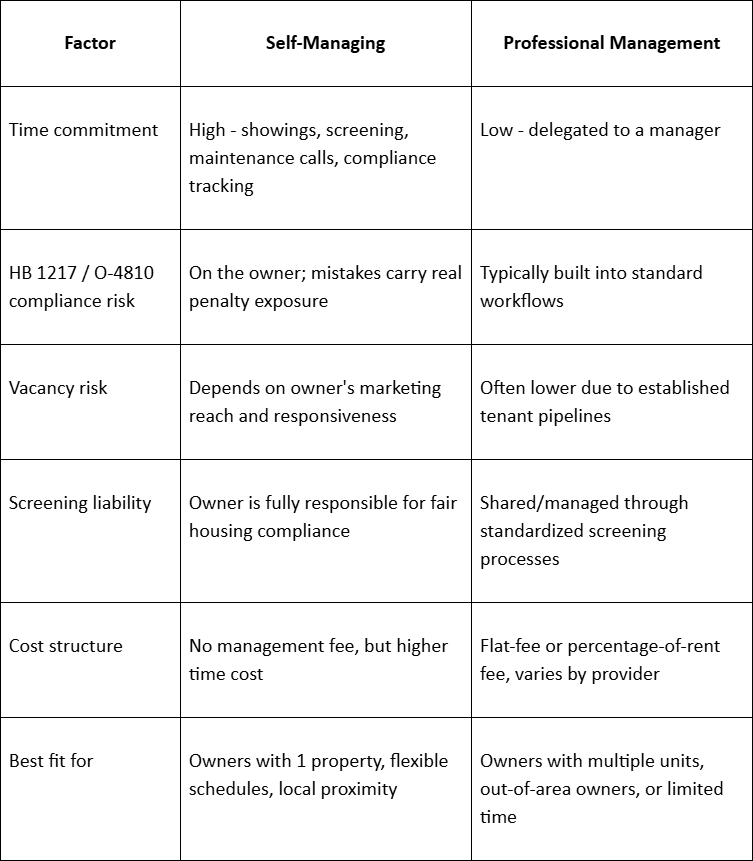
The real trade-off isn’t “cost vs. no cost”, self-managing has a cost too, it’s just measured in hours and risk rather than a monthly fee. Vacancy time, a botched notice, or a screening decision that runs afoul of fair housing rules can easily exceed a year’s worth of management fees.
On fee structure specifically: percentage-of-rent models are still common, but flat-fee management has been gaining traction with landlords who want predictable costs regardless of what rent is charging in a given month. That’s worth asking about directly when comparing providers, since a percentage fee on a waterfront Houghton unit and a flat fee on the same unit can produce very different annual costs.
What Smart Eastside Landlords Do Differently in 2026
The landlords doing well in this market share a handful of habits that go beyond just knowing the law.
They time renewals ahead of the rent cap, not around it. Rather than waiting until a notice deadline is close, they build renewal timelines backward from the longest plausible local notice window, so a slow mail delivery or a missed signature doesn’t cost them a full cycle.
They price by submarket, not by city average. A Totem Lake comp doesn’t tell you what a Moss Bay waterfront unit should rent for. Smart owners pull neighborhood-level data rather than relying on citywide averages that flatten out real differences in demand.
They maintain vetted local vendor relationships. Habitability obligations under Kirkland’s tenant-protection ordinance mean maintenance response time isn’t just a service issue, it’s a compliance issue. Having contractors on call before something breaks matters more in Kirkland than in markets without local habitability standards layered on top of state law.
They choose fee transparency over guesswork. Flat-fee management has appeal precisely because it removes the incentive misalignment that can come with percentage-based fees, and it makes year-over-year cost comparisons straightforward.
If you’re weighing whether to keep managing a Kirkland rental on your own or bring in support for the 2026 compliance environment, Kirkland property management from Next Brick is built around exactly these practices, proactive renewal timing, submarket-level pricing, and flat-fee transparency.
Getting Started: Managing a Kirkland Rental the Right Way
For owners weighing their options going into 2026, a few practical steps make the DIY-vs-PM decision easier:
- Audit your current lease documents against HB 1217’s notice format and Kirkland’s O-4810 habitability requirements before your next renewal comes up.
- Map out your 12-month anniversary dates across all units so no rent increase notice gets rushed or missed.
- Decide your fee-model preference, flat-fee vs. percentage-of-rent, before comparing management options, since that changes what “cost-effective” actually means for your portfolio.
- Get a neighborhood-level rent comparison rather than relying on citywide averages, especially if you own in Houghton, Moss Bay, downtown, or Totem Lake, since each behaves differently.
Kirkland also has no rental registration program and no first-in-time leasing rule, which puts it in a different position than Seattle on some tenant-screening logistics, but it does allow tenants to terminate a lease early for documented safety concerns such as domestic violence or stalking, and its habitability standards go beyond baseline state requirements. These are worth building into your screening and lease-renewal process now rather than discovering them mid-tenancy.
Frequently Asked Questions
How much can a landlord raise rent in Kirkland in 2026?
Up to 9.683% in any 12-month period, after the tenant’s first 12 months in the unit, per the statewide cap under HB 1217.
Do I need a property manager for a rental in Kirkland?
Not strictly, plenty of owners self-manage successfully, particularly with a single property and local proximity. But the compliance layer added by HB 1217 and Kirkland’s O-4810 has raised the cost of getting things wrong, which is pushing more owners, especially those with multiple units or limited time, toward professional support.
What notice is required before raising rent in Kirkland, WA?
The statewide minimum is 90 days, but Kirkland may require longer, reporting varies between 120 and 180 days depending on the increase. Confirm the current figure for your property before sending a notice.
What does property management cost in the Seattle/Eastside area?
Costs vary between percentage-of-rent and flat-fee models; flat-fee structures are increasingly preferred for their predictability regardless of monthly rent.
Is Kirkland a good place to own a rental property?
The fundamentals, Lake Washington access, the Kirkland Urban/Google campus effect, and inclusion in the Lake Washington School District, continue to support solid rental demand, though the regulatory environment now requires more careful compliance management than in prior years.
In Summary
Managing a Kirkland rental well in 2026 comes down to treating compliance as a workflow, not a one-time read of the law, and understanding that Kirkland’s neighborhoods don’t behave like a single market. Whether you continue self-managing or bring in help, those two habits are what separate landlords who stay ahead of the changes from those catching up after the fact.
If you’d rather hand that workflow off, Next Brick offers a straightforward next step for owners managing a Kirkland rental who want the compliance and pricing work handled for them.