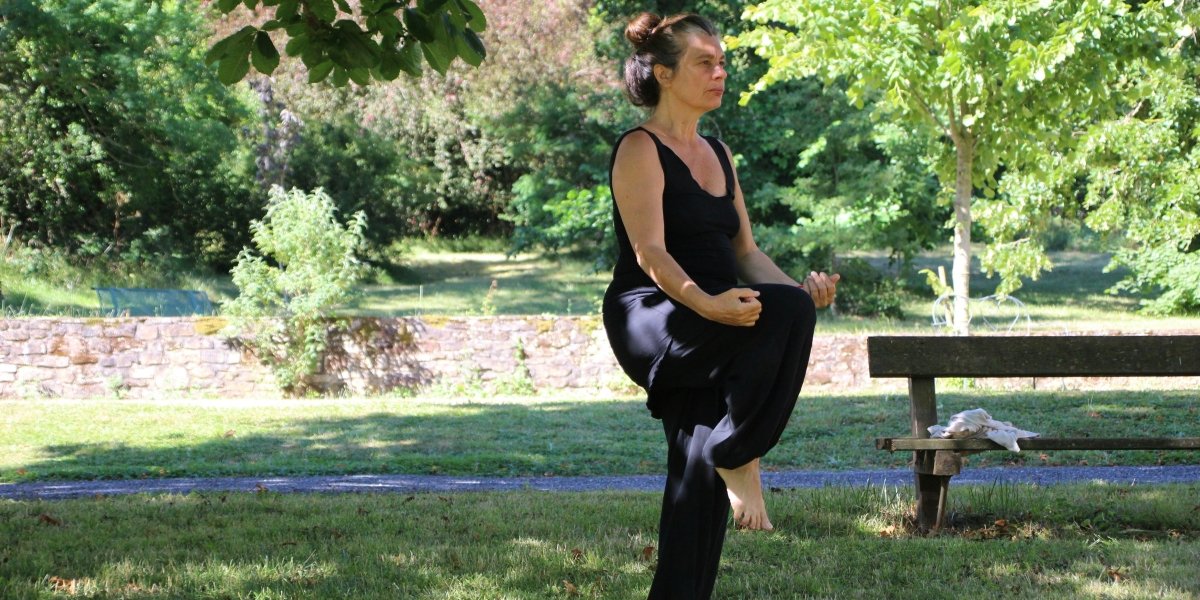
A randomized trial published Sept. 23, 2026, found that a simplified tai chi program improved a standard mobility test in older adults with knee osteoarthritis and muscle loss. For West Orange homeowners who picked their neighborhood for its trails and walkable downtown, the results add to the list of options worth discussing before joint replacement.
By Alena Wiese
A homeowner may have chosen a house in Horizon West for the sidewalks, the neighborhood pool and the easy bike ride to Plant Street on a Saturday morning. Years later, the same person may notice that the walk to the mailbox feels longer, that the stairs to the bonus room are taken one at a time, and that rising from a low patio chair now takes a hand on the armrest.
Knee osteoarthritis often changes how people use the homes and communities they chose long before it changes where they live. Can anything short of surgery help them keep moving? For many people, current research says yes: exercise, weight management and other conservative care are first-line options, and a new trial adds evidence for one gentle, low-impact form of movement.
On Sept. 23, 2026, the journal Osteoarthritis and Cartilage Open published a randomized clinical trial of 96 adults ages 65 to 85 who had knee osteoarthritis along with age-related muscle loss, a combination researchers call sarcopenic knee osteoarthritis. After 12 weeks, the group assigned to a simplified 8-form tai chi program was 2.52 seconds faster on the Timed Up and Go test than a comparison group that received health education and a home exercise program.
What did the new tai chi study actually measure?
The study measured everyday mobility, using the Timed Up and Go test, a common clinical check in which a person stands from a chair, walks a short distance, turns, returns and sits back down.
Researchers at two sites in Shanghai, China, randomly assigned 48 participants to tai chi and 48 to the comparison program. The tai chi group began with four supervised 60-minute sessions during the first two weeks, then practiced at home five days a week for about 30 minutes a day through week 12.
In this study:
- Clinically meaningful improvement was more common with tai chi: 28 of 48 participants (58.3 percent) versus 6 of 48 (12.5 percent).
- At week 26, a smaller advantage of 1.46 seconds remained.
- A standard arthritis questionnaire measure of pain favored tai chi, while a separate visual analog pain scale showed no clear difference between groups.
- The authors reported no intervention-related serious adverse events.
Source: Effect of 8-Form Tai Chi vs Health Education on Mobility in Older Adults With Sarcopenic Knee Osteoarthritis: A Randomized Clinical Trial, Osteoarthritis and Cartilage Open, September 2026. https://www.sciencedirect.com/science/article/pii/S2665913126001391
What does the tai chi study not show?
It does not show that tai chi will delay or replace a knee replacement; the trial did not measure surgery rates, and the authors list several limits.
The sample was modest. Participants came from two sites in a single urban district in Shanghai, which may limit how well the findings apply elsewhere. Follow-up stopped at 26 weeks, and fewer participants completed later measurements. Home practice was tracked partly through self-reported logs, and the two programs differed in both content and contact time, so the benefit cannot be pinned on any single element of tai chi.
The authors also noted that the average week-12 improvement fell slightly below the threshold they had set in advance for a meaningful change in an individual person. Men made up 62 of the 96 participants, even though osteoarthritis is more common in women. Results may differ for younger or stronger people without measurable muscle loss.
Can walking the local trails help arthritic knees?
For many people with arthritis, regular activity helps: the Centers for Disease Control and Prevention says physical activity “can improve function, mood, and quality of life for adults with arthritis.” The CDC recognizes more than 20 lifestyle management programs for arthritis, including Walk With Ease, Tai Chi for Arthritis and the Arthritis Foundation Aquatic Program.
The paved West Orange Trail runs 22.32 miles through Killarney, Oakland, Winter Garden and on to Apopka, according to Orange County Parks, and it is open sunrise to sunset for walking, cycling and skating. The Winter Garden Station sits at 455 E. Plant St., at the edge of downtown Winter Garden.
That access matters in a growing area. The U.S. Census Bureau estimates Winter Garden’s population at 48,063 as of July 2025, with 13.8 percent of residents 65 or older. A flat, paved route lets people with knee pain build walking time gradually.
The American College of Rheumatology’s 2026 guideline update, approved in September, strongly recommends exercise for knee and hip osteoarthritis and conditionally recommends tai chi.
Source: Physical Activity and Self-Management Education Programs for Arthritis, Centers for Disease Control and Prevention, June 2026. https://www.cdc.gov/arthritis/programs/index.html
Source: West Orange Trail, Orange County Parks and Recreation, accessed September 2026. https://www.orangecountyfl.net/cultureparks/parks.aspx?d=44&m=dtlvw
When should knee pain be checked instead of waited out?
Knee pain deserves an evaluation when it starts changing routines, such as skipping stairs, avoiding the trail or rearranging a home around a sore joint. Some symptoms call for prompt medical care rather than a conservative program:
- A hot, red, swollen knee, especially with fever, which can signal infection.
- A knee that suddenly cannot bear weight after a fall or twist.
- A knee that locks or gives way repeatedly.
- Swelling, warmth and pain in one calf, which can signal a blood clot and needs emergency care.
- Several swollen joints with long-lasting morning stiffness, which may point to an inflammatory arthritis that needs a physician.
Where does a non-surgical clinic fit before joint replacement?
A non-surgical clinic fits at the evaluation stage, when the goal is to understand what is driving a person’s knee pain and which conservative options are reasonable. ReliefNow Disc Joint and Nerve Center Hamlin, at 5736 Hamlin Groves Trail, Suite 154, Winter Garden (407-706-4944), serves Hamlin, Horizon West, Winter Garden and Windermere. The clinic states that every plan starts with an evaluation.
Dr. Jeffrey N. Shebovsky, DC, founded Orange Wellness in 1994 and has more than 30 years of clinical experience. Services listed at the Hamlin location include Knee-on-Trac knee decompression and Class IV laser therapy. The tai chi trial did not study those treatments, and anyone considering a device-based therapy can reasonably ask a provider what evidence supports it for their situation.
Conservative care is a reasonable starting point for many people with mild to moderate knee osteoarthritis. It is less likely to be enough when X-rays show advanced joint damage, pain disrupts sleep most nights, and daily function keeps declining despite months of consistent care. In those cases, a referral to an orthopedic surgeon to discuss joint replacement is appropriate.
Progress is best measured with repeatable, practical markers: how long it takes to rise from a chair, how far a person can walk before stopping, how stairs feel, and how pain scores change over weeks.
For many West Orange residents, the house was never just a house. It was the trail at the end of the street and the walk to Plant Street on a Saturday. Keeping the knees moving is one way to keep that life within reach, one ordinary step at a time.
ABOUT: Dr. Jeffrey N. Shebovsky, DC | ReliefNow® Disc Joint & Nerve Center Hamlin | 5736 Hamlin Groves Trail, Suite 154, Winter Garden, FL 34787 | 407-706-4944 | https://reliefnowlaser.com/providers/hamlin/
This article is for informational purposes only and does not constitute medical advice. Consult a qualified healthcare provider before beginning any treatment program.