Drainage is rarely the first thing investors think about when they review a cost segregation study. Yet how drainage systems are classified can change how quickly an owner recovers the cost of a property through depreciation. According to CostSegRx, an engineering-based cost segregation firm, it is also an area that owners and some providers regularly overlook.
The question comes down to one line: which drainage components are part of the building, and which are separate land improvements?
Building Drainage vs. Site Drainage
Land improvements fall under asset class 00.3. To decide where a drainage component belongs, CostSegRx looks at whether it supports the maintenance and operation of the building itself.
Gutters along the roofline and the downspouts that carry water down the sides of the building are good examples. They protect the structure, so they are treated as part of the building. That makes them Section 1250 property, depreciated over 39 years for commercial buildings or 27.5 years for residential rental property.
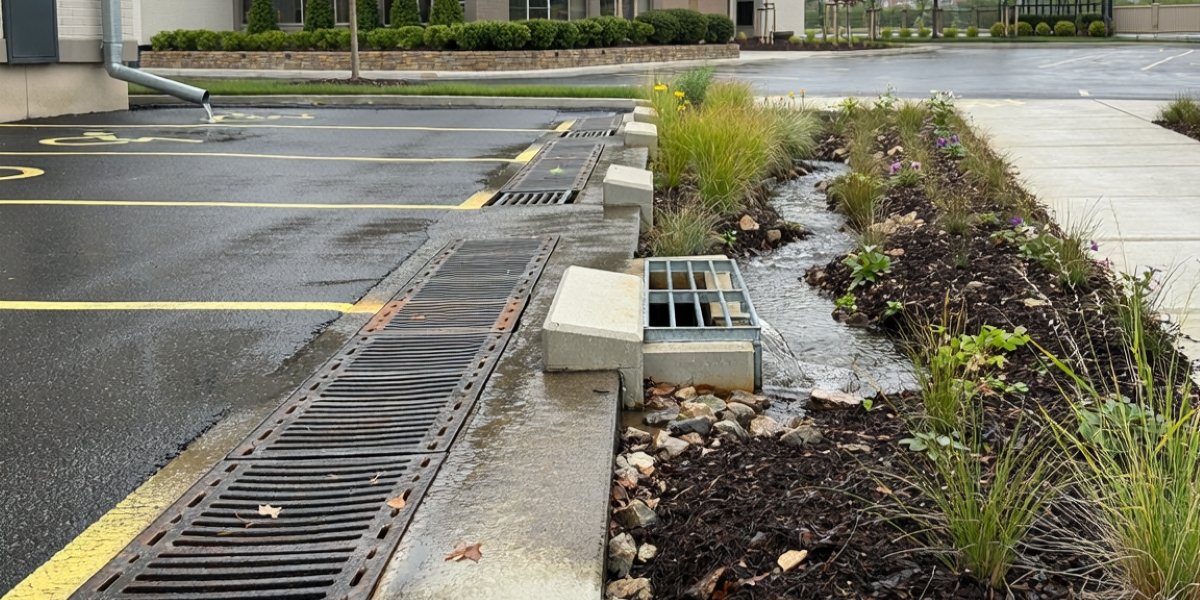
Drainage that serves the site is treated differently. Storm drain inlets in the middle of a parking lot and the gutters that run along roads on the property are generally classified as 15-year land improvements. Where 100% bonus depreciation is available, those costs can be deducted in the first year rather than spread across decades.
The Question That Decides Classification
For components like trench drains, catch basins, and grading work, the test is what the system actually does. “We’re always looking at what it is truly serving,” said Brian Kiczula of CostSegRx. “Is it serving the site or is it serving the building itself?” In the firm’s experience, the answer is the site more than half the time.
Retention ponds are another example. CostSegRx performs many site inspections in Florida, where retention ponds are a familiar feature in many communities, often with a fountain or other water feature. Using construction cost estimating, those items can be valued and moved into shorter depreciation lives.
There is an important exception. Some site work is not about managing water at all but about making the land buildable. If a hill has to be removed or a lot has to be leveled before construction can begin, that cost is tied to the land, because the same work would be needed for any building. It is not part of the structure, and it is not a short-life asset. Land is not depreciable.
That is why the purpose of the work matters as much as the work itself. Whether it is grading or new drainage, the key question is why that construction was done on the property.
The Most Common Classification Mistake
The error CostSegRx sees most often is failing to recognize site assets at all and placing everything in the 39-year building category. It is a broad-brush approach that treats driveways, sidewalks, parking lots, and site drainage as straight-line building costs.
The firm has seen this with property owners using DIY cost segregation tools that assign no value to site improvements, and with some cost segregation providers as well. Court cases and the IRS Cost Segregation Audit Technique Guide offer many examples of assets that can properly be reclassified as site improvements.
Why the Distinction Affects the Outcome
If a site improvement is missed, it stays in the 27.5-year or 39-year category and is recovered slowly through straight-line depreciation. If it is correctly identified and valued at fair market value as a 15-year asset, it may qualify for bonus depreciation in the year the property is placed into service.
For owners reviewing a study, a useful step is to look at how site work was handled. Is parking lot drainage separated from roof drainage? Are retention ponds and site grading addressed, and is the reasoning explained? CostSegRx’s case studies show how these classifications play out across different property types. As with any study, the results should be reviewed with a CPA before filing.
About CostSegRx: CostSegRx is an engineering-based cost segregation firm led by Brian Kiczula, a member of the American Society of Cost Segregation Professionals. The firm works with residential and commercial real estate investors nationwide. CostSegRx provides complimentary estimates of benefit and supports investors and their CPAs through the full reporting process. Learn more at costsegrx.com or call (888) 850-4155.
Disclaimer: This article is based on information provided by the expert source cited above. It is intended for general informational purposes only and does not constitute legal, financial, or real estate advice. Readers should conduct their own research and consult qualified professionals before making any real estate or financial decisions.