
An agent who has sold homes on the same few blocks for a decade types her neighborhood’s name and “homes for sale” into Google. The first page fills with national property portals and listing aggregators. Her own website, built around the streets she knows best, doesn’t appear. For many individual agents, that search is where real estate SEO conversations begin, and often where frustration starts, too. The more useful question is where an agent can realistically win at all.
Where SEO for Real Estate Agents Breaks Down
Listing searches are the most visible real estate queries online, and individual agents are least likely to rank for them. Phrases such as “homes for sale in” a city, or that city’s name followed by “real estate,” tend to return the same national portals in market after market, with brokerage sites and local agents pushed further down the page.
Many agents respond by paying for more content, more ads, or a new website aimed at those terms. The gap rarely closes. The problem is structural, not a matter of effort, and that distinction changes where the money should go.
Why the Portals Win
Property portals publish millions of listing pages that refresh as homes come on and off the market. They attract links from news coverage, data reports, and other sites at a scale no single agent can approach, and they draw enormous repeat traffic from buyers who browse for weeks or months. Search engines read all of that as relevance for listing queries.
“A portal is built to answer one question better than anyone: what’s for sale right now,” said Edmond Abramyan, founder of Curious Fortune Media. “When an agent spends money trying to rank for that search, they’re fighting on the portal’s strongest ground instead of their own.”
Buyers may browse on portals, but they still hire people. According to research released by the National Association of Realtors in April 2026, 88% of buyers purchased through an agent, and 91% said they would use their agent again or recommend them. NAR’s 2025 Profile of Home Buyers and Sellers found that referrals were the largest single source for finding an agent, at 43%. That points to a different job for an agent’s online presence: being the person a buyer can verify and trust.
The Searches Portals Don’t Own
Listing pages poorly serve many real estate searches. Comparisons between two neighborhoods, questions about school boundaries or commute times, “how to sell a house in” a specific area, and plain-language explanations of what is happening in a local market all call for knowledge rather than inventory. Hyperlocal content written by someone who works those streets can compete for these searches in a way a portal page usually cannot.
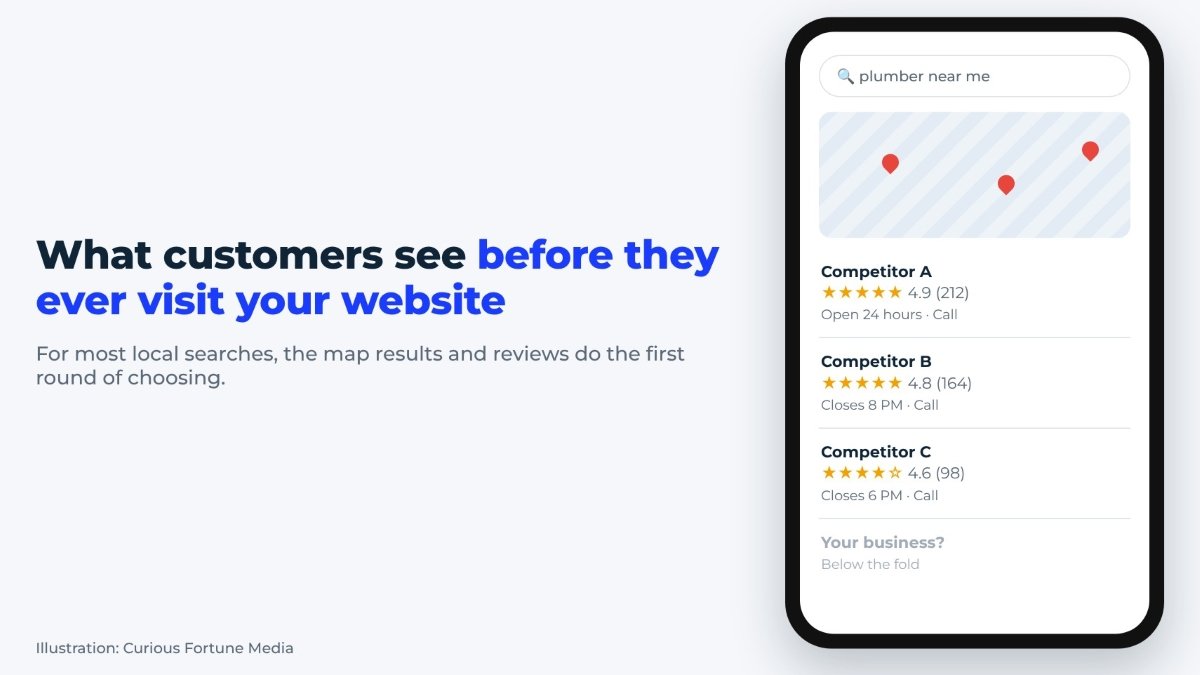
The local map pack is another opening. Google’s own guidance on local rankings says results are based on relevance, distance, and prominence, and that prominence draws on factors including how many websites link to a business and how many reviews it has. A complete, active Google Business Profile tied to a specific service area gives an individual agent a place in search results that does not depend on outranking a portal.
Credibility Is the Agent’s Edge
Once a buyer or seller moves past browsing, the decision turns on proof. Review volume and recency, a visible transaction history in the area, a named agent with real neighborhood knowledge, and consistent business details across the web all help a prospect decide who is worth calling.
“Nobody hires an agent from a directory of realtors,” Abramyan said. “They hire the person who clearly knows the street, the school lines and what sold last spring, and who has the reviews to back it up. That’s the one thing a portal can’t list.”
Search itself is raising the stakes. A 2025 Pew Research Center analysis found that Google users clicked a traditional search result in 8% of visits when an AI summary appeared, compared with 15% when none did, and only 1% clicked a link inside the summary. Because AI-generated answers summarize local options and name only a few professionals, agents with clear, consistent credibility signals are more likely to be named.
Abramyan developed the Authority Engine™ at Curious Fortune Media in three layers: visibility, authority, and conversion. For an agent, the authority layer does the heavy lifting, turning neighborhood knowledge and reviews into the proof a buyer checks before picking up the phone.
A Longer Game, With Limits
The split is fairly clean. Portals win inventory searches, and individual agents can win expertise searches. For most agents, that suggests shifting budget away from competing on listing keywords and toward neighborhood-level content, an active Google Business Profile and a steady flow of genuine reviews.
There are limits. Portals will remain the main place buyers browse listings, and agents are unlikely to drop them from their marketing mix. Credibility also builds slowly, with reviews, local content, and recognition in AI answers accumulating over months rather than weeks.
The agents best positioned over the next few years may not be the ones who finally crack a “homes for sale” search. They may be the ones a buyer finds when asking which neighborhood to choose, and already trusts by the time a listing catches their eye.