Founders tend to hear one of two stories: “Nobody lends to startups” or “Anyone can get funded today.” Neither is accurate, and either one can steer you badly wrong. This piece takes the claims you’re likely to run into and gives each one a plain verdict: yes, no, or sometimes, along with the reasoning.
Examples are illustrative and use fictional companies. Lender requirements vary, and none of this is a promise of approval.
Verdict 1: “A Bank Will Give My Brand-New Company a Conventional Term Loan”
NO, in most cases. Without personal strength behind it, a pre-revenue company rarely fits a conventional bank’s credit box.
A term loan is repaid from predictable cash flow, and a startup can’t yet show any. Banks commonly want two or more years of returns. The exceptions usually involve a founder with substantial personal assets, an existing relationship, or strong collateral, and in those situations the bank is really lending on the founder.
Verdict 2: “A Startup Can Get an SBA-Backed Loan”
SOMETIMES. It is possible, though it demands preparation and patience.
Startups aren’t excluded from SBA programs. Lenders often expect relevant industry experience, a detailed plan with projections, an owner’s cash injection, and a personal guarantee. The SBA’s microloan program, delivered through nonprofit intermediaries, can reach up to $50,000 and is often more open to very young businesses. Community development lenders may be worth a call too. They may offer coaching along with capital, which is rarely true of a faster source.
Timelines are usually measured in weeks or months. Begin well before you need the money.
Verdict 3: “Online Lenders Fund Term Loans for Companies of Any Age”
NO. Most online term lenders set a minimum time in business and a minimum revenue.
The threshold differs by provider, but several months to a year or more is common for term products. An advertisement that says “startups welcome” may be defining startup as a business with a year of deposits. A general overview, such as Fundivi term loans for startups, can show you the kind of information a provider will ask for, and the eligibility details should always be confirmed for your own situation.
Verdict 4: “Six Months of Strong Deposits Might Be Enough”
SOMETIMES. A few providers will consider it, generally with short terms and higher pricing.
Ashgrove Dog Wash, a fictional two-location grooming business, has eight months of history and about $4,200 in monthly cash flow available for debt payments. It gets two quotes for $60,000.
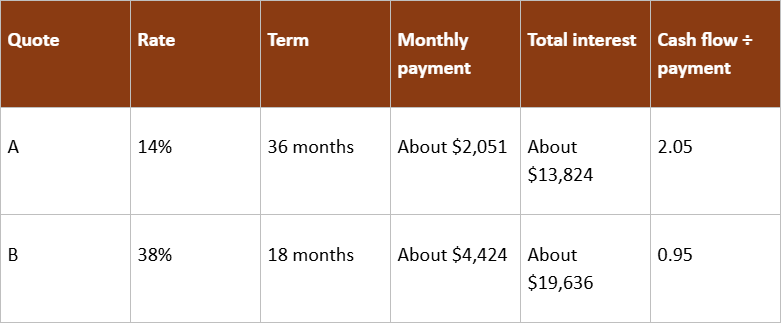
The final column is the debt service coverage ratio. Lenders often look for something comfortably above 1.25. Quote B’s payment exceeds the available cash, so it fails the test even if somebody were willing to fund it. An approval is not proof of affordability.
Quote A is the kind of offer a startup with unusually strong credit might see. Founders with thin credit should expect something closer to B, or a smaller offer.
Verdict 5: “My Personal Credit Doesn’t Matter Since It’s a Business Loan”
NO. For a startup, personal credit is often the main thing a lender can evaluate.
Since the business has no record, your personal history is the nearest available evidence of how you handle debt. Expect a personal guarantee on most startup financing. Forming an LLC doesn’t shield you from a debt that you’ve personally guaranteed.
Before applying, pull your reports, dispute errors, and bring down revolving balances. Those steps are free and can affect both approval and pricing.
You may also get pitched an advance as a way around the credit question. To understand that trade, founders can turn to a comparison resource like BestMCALoans.com startup financing explainers, which is particularly relevant if you’re trying to learn how advance products differ from installment debt.
Verdict 6: “Collateral Can Make Up for a Short History”
YES, to a degree. Collateral reduces a lender’s risk, though it doesn’t produce cash flow to make the payments.
Real estate, equipment, or a pledged savings account can open doors. Equipment financing is the most obvious version, because the purchased machine secures the debt. Ashgrove compares a $45,000 loan for its grooming tables and dryers at 11% over 72 months: about $857 a month and about $16,670 in total interest. Be careful about what is pledged. If your home is securing the loan, then a failed business can put your home at risk.
Verdict 7: “If I Take Card Payments, There’s Another Route”
SOMETIMES. Card history can substitute for a longer record, but what you get usually isn’t a term loan.
Financing tied to card receipts looks at processing volume, which a young merchant may be able to show. A USA Today release on card-processing loans describes one launch of this kind. Compare it with a term loan on total repayment, payment frequency, and how payments behave when sales slow down.
Verdict 8: “A Great Business Plan Will Win Over the Lender”
SOMETIMES. It’s necessary for SBA and community lenders, and largely irrelevant to automated underwriting.
A plan helps most when a human reviews it. Effective ones contain conservative projections, a monthly cash flow forecast, a break-even calculation, and a clear account of how the loan will be spent. An online lender that underwrites from bank data probably won’t read one at all. Write it anyway, because the exercise of finding your break-even month helps you decide how much to request, and whether to request anything.
Verdict 9: “A Co-Signer or Partner Can Help”
YES, often. A partner with strong credit or income may improve the file, and that partner takes on real liability.
Lenders commonly require guarantees from owners above a certain ownership share, so adding a partner may bring in their credit whether or not it helps. Have a frank conversation, and put the arrangement in writing, because a guarantee can outlast a friendship.
Verdict 10: “A Term Loan Is the Right Tool for a Startup”
SOMETIMES. It suits a defined, one-time cost. It’s a poor match for ongoing losses.
A fixed payment beginning next month is demanding for a business without steady revenue. If you’re buying equipment or fitting out a location, a term loan may fit well. If you’re covering payroll until customers appear, the debt may just add a payment to the problem. Look carefully at when the first payment falls due, since some lenders start collecting within weeks of funding, well before a new location has opened its doors.
Other structures may match irregular expenses better. A list of working capital loans available online offers a starting point for comparing shorter, more flexible products.
A Startup’s Pre-Application Checklist
☐ Personal credit reports reviewed and corrected
☐ Business formation, EIN, licenses, and bank account in place
☐ Twelve-month cash forecast with a low case
☐ Specific use of funds, with quotes where possible
☐ Owner’s cash contribution documented
☐ Payment tested against the low case
Keep the same discipline when offers arrive. Write each one in the same format: net proceeds, payment, term, total repaid, fees, collateral, and guarantees. Offers that seem incomparable on the phone become comparable on one sheet of paper.
If the payment fails the low case, try a smaller amount, a longer term, or a delayed start. Revisit the application after you’ve built a few more months of history, since age alone may improve your next quote.
Frequently Asked Questions
How old does a business need to be to get a term loan?
There’s no single rule. Banks commonly want about two years, while some online lenders accept less.
How much can a startup borrow?
Often a modest amount at first. Microloans can reach $50,000, and other limits depend on credit, collateral, and cash flow.
Do I need a down payment?
Many SBA and equipment loans for new businesses expect an owner contribution. The share varies by lender and program.
Can I use a term loan to pay myself?
Some lenders restrict this. State the intended use honestly, as misrepresenting it can create serious problems.
What if I’ve been declined?
Ask for the reasons. Fix what you can, try a community lender, or reduce the amount you’re asking for.
Are startup loans more expensive?
Typically, because lenders are pricing in higher uncertainty. Refinancing may be possible later as your record improves.
Is a personal loan a good substitute?
It can be faster and simpler, but you carry the debt personally, and the amount may not meet your need.