
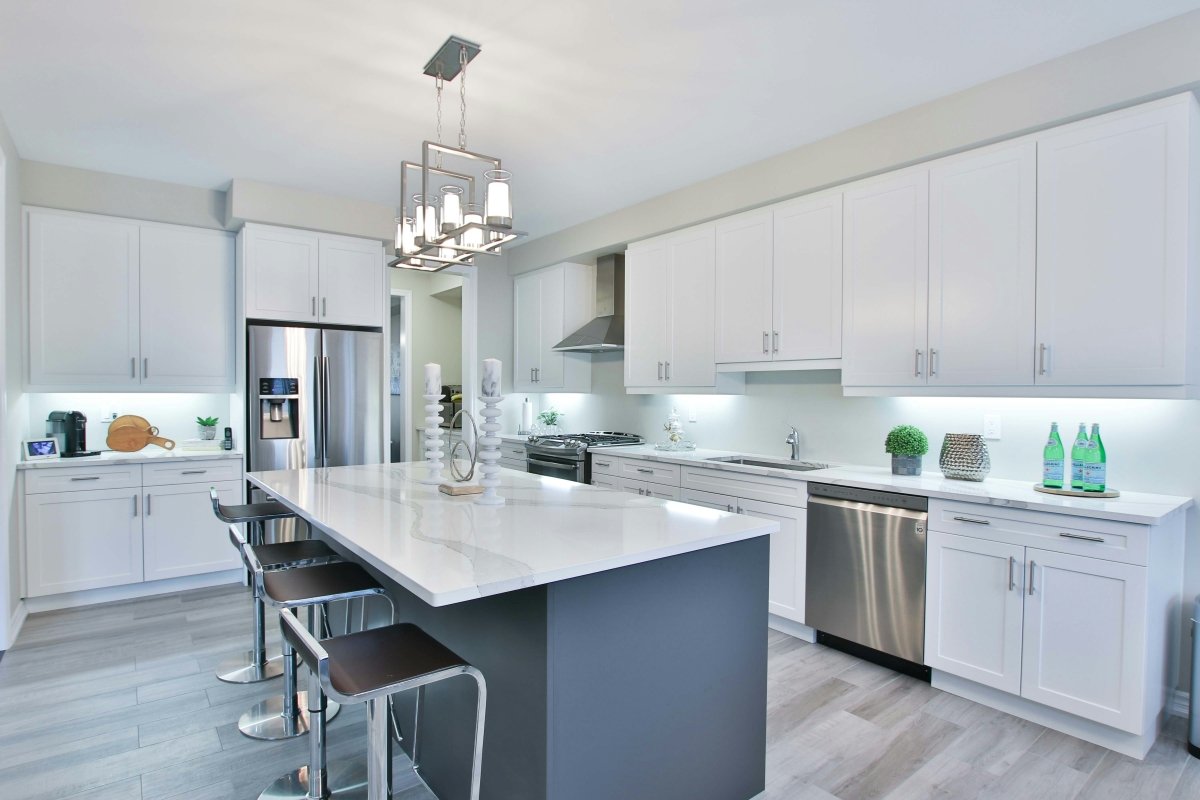
What does HomeWise do with houses after closing? It repairs them and resells them. One featured project on the company’s site was restored to market-ready condition within 60 days of purchase. The resale price sits above the purchase price because it carries the repair bill, the months of holding cost, and the margin already priced into the original offer.
Consider a hypothetical 1974 three-bedroom in Bakersfield, California, sold as-is in February 2026 for $205,000. Over five months, the buyer spends $48,000 on a roof, ductwork, flooring and a kitchen, plus about $9,000 on taxes, insurance and utilities. It closes again in August at $296,000, which looks like $91,000 of profit. After repairs, holding costs, and roughly $16,000 of commission and closing costs on the way out, about $18,000 is left. The figures illustrate the trade, not a HomeWise transaction.
What happens in the first 60 days after closing?
The sequence rarely varies, because each step gates the next.
1. Closing and possession. The title company confirms clear title, records the deed, and pays the seller. Nothing starts until the house belongs to the buyer.
2. Clear-out and assessment. What was left behind goes to a dumpster or a donation truck, and a contractor prices what a walkthrough could not see: rot under a shower pan, brittle wiring, a cracked drain line.
3. Scope and permits. The buyer picks a finish level matching renovated houses nearby. Structural, electrical, plumbing and roof work goes on permit, and an inspector signs off before drywall closes a wall.
4. Trades in sequence. Roof, systems and windows first, then drywall, cabinets, counters, paint and floors. Run out of order, finish work gets damaged and paid for twice.
5. Back on the market. Photographs, a listing priced against comparable renovated sales, and a retail buyer who usually arrives with a mortgage, an appraisal, and an inspection of the finished work.
What does the spread between purchase and resale actually pay for?
According to ATTOM’s 2025 year-end U.S. Home Flipping Report, released March 19, 2026, 297,045 single-family homes and condominiums were flipped nationwide in 2025, the fewest since 2020. The typical flipped home was bought for $259,019 and resold for $325,000, a gross profit of $65,981 and a 25.5 percent return, the lowest rate ATTOM has recorded since 2008. The word gross carries the weight. ATTOM measures only the difference between the two sale prices, and its methodology leaves out rehab costs and other expenses, which flipping veterans estimate at 20 percent to 33 percent of a property’s after-repair value. Take that range out of the median example, and most of the $65,981 is gone.
Time is the other line. ATTOM put the average span from purchase to resale at 163 days in 2025, about five and a half months of taxes, insurance, utilities and, for the 37.7 percent of flips bought with financing, loan interest. “Competition for homes remains strong in many markets due to constrained supply,” said ATTOM chief executive Rob Barber in the same release. Projects are won or lost at the purchase price.
Is the repair money real money?
The federal statistical system counts it as construction. The Census Bureau’s Value of Construction Put in Place survey measures improvements to existing structures alongside new building, and its definitions page lists what qualifies: “Additions, alterations, conversions, expansions, reconstruction, renovations, rehabilitations, and major replacements (such as the complete replacement of a roof or heating system).” Maintenance and small repairs are excluded. A house needing a roof and a heating system needs the expensive category, and that bill falls on whoever holds the deed while the work is done.
The Bakersfield example, line by line:
|
Line |
Basis |
Amount |
|---|---|---|
|
Resale price |
Closed in August, renovated |
$296,000 |
|
Purchase price |
Paid to the owner in February |
minus $205,000 |
|
Repairs |
Roof, ductwork, flooring, kitchen |
minus $48,000 |
|
Holding and resale costs |
Five months of carrying costs, then commission and closing costs |
minus $25,000 |
|
What remains |
Return on capital and renovation risk |
$18,000 |
Any flipping houses calculator online runs those same five lines, and the answer moves fast: a $70,000 repair bill on this house turns the $18,000 into a loss. That is why offers on houses needing work land below the renovated price, and why an optimistic repair estimate is the buyer’s problem.
Does a higher resale price mean the seller was underpaid?

Not by itself. Deed records are public, so an owner who checks the address a year later sees a bigger number attached to a house that now has a new roof, new systems and a new kitchen. On paper, those are two different houses. The narrower comparison is the useful one: what the seller took at closing versus what a listing would have netted after the same repairs, commission, and months of carrying costs. A homeowner who searches “real estate investors near me” and collects three as-is offers learns more than any resale figure can tell.
Buyers such as HomeWise take the renovation risk in exchange for the discount, and that risk is not theoretical. Budgets break on what is behind the walls, mortgage rates move while the crew works, and a house that sits unsold keeps billing its owner every month.
Where does HomeWise fit?
HomeWise, a direct home-buying company that purchases distressed single-family houses in California, Texas, Florida, Arizona, Georgia and other states, buys as-is with no repairs, cleaning, staging or showings required, and has purchased more than 500 homes. The company states that it buys with its own capital and closes itself rather than passing the contract to another investor, and charges no agent commissions, listing fees or service fees, though prorated property taxes and HOA dues at settlement can still apply. Its account of a project restored to market-ready condition within 60 days comes from the published pages of HomeWise rather than from an independent audit of any single house.
The company’s about page carries the same terms: more than 500 homes purchased, offers in as little as one hour, closings in as few as seven days once title is clear. No buyer can honestly promise that every project finishes on schedule or at its underwritten price.
Frequently asked questions
Does HomeWise renovate and resell the houses it buys?
The company’s own site describes a purchased house restored to market-ready condition within 60 days, which is a renovation-and-resale cycle. Nothing in that changes the seller’s side of the deal: the price is agreed before closing, the funds arrive at closing, and any later work on the house is the buyer’s cost and risk.
How does a seller judge the best real estate investors in a market?
By asking the four questions HomeWise’s own pages put to sellers: Is the buyer using its own funds or passing the contract along? Can it show proof of funds? Does it have verifiable reviews? And will it put the terms in writing? Those answers separate a funded buyer from a middleman faster than any advertised offer range.
Can a seller use a flipping houses calculator to check an offer?
Yes, as a sanity check. Entering the renovated value, a contractor bid, a holding period, and a resale cost of about 6 percent shows what is left for the buyer. If that residue is small at the offered price, the offer is tight. If it looks like a fortune, the repair estimate deserves a second look.
What if the house resells within weeks instead of months?
A fast resale usually means light work, and light work argues for a smaller discount in the first place. That point is worth raising before signing, not after. A seller who suspects the repair line was inflated can send a dated contractor bid and ask the buyer to run its numbers again.
Disclaimer: This content is for general informational purposes only and should not be considered as financial advice. The content is not intended to be a substitute for professional financial advice, investment advice, or any other type of advice. You should seek the advice of a qualified financial advisor or other professional before making any financial decisions.