By KeyCrew Media
Austin’s Mueller neighborhood has maintained a rare commitment to economic integration even as property values have climbed above surrounding areas. A quarter of all housing, both rental and for-sale, is designated as permanently affordable and deliberately indistinguishable from market-rate homes.
How a Closed Airport Became a Blueprint for Integrated Housing
Mueller’s affordability program did not emerge from a government mandate imposed after the fact. According to Kathy Sokolic, a real estate professional with Mueller Residential Group who has lived in the neighborhood since its early development, the commitment traces back to the community planning process that followed the relocation of Austin’s original airport. When the airport closed and the land became available for development, surrounding neighborhoods were given input on what they wanted to see built. Some of those communities pushed for housing at specific price points, and the result was a commitment to keep 25% of Mueller’s housing affordable, not just for a trial period, but permanently.
“We’re now trying to keep 25% in perpetuity,” Sokolic says. The distinction matters. Many affordability programs sunset after a fixed term, allowing units to convert to market rate once the obligation expires. Mueller’s mandate is designed to hold regardless of how much surrounding values appreciate.
Who Actually Lives in the Affordable Units, and Where
The residents using Mueller’s affordable housing are not a demographic outlier. Sokolic describes the program’s beneficiaries as teachers, nonprofit employees, municipal workers, and grocery store workers, the service and civic workforce that typically gets priced out of desirable urban neighborhoods as they mature.
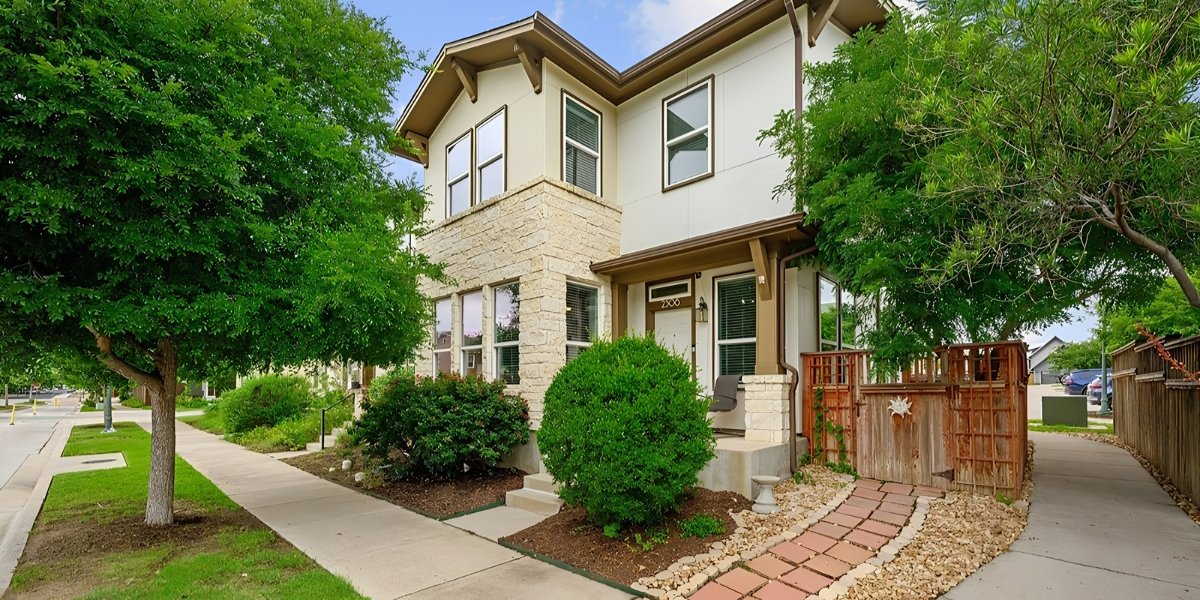
What makes Mueller’s approach structurally different from many mixed-income developments is the physical integration of affordable units. Rather than clustering them in a designated section, affordable homes sit alongside market-rate single-family homes, townhomes, and condos throughout the 720-acre neighborhood, with no architectural differentiation. “You wouldn’t be able to know that that was low-cost housing,” Sokolic says.
This is not a minor design detail. In many cities, affordable housing is visually and spatially separated from market-rate development, reinforcing social stratification and stigmatizing residents. Mueller’s model makes that distinction invisible.
A Price Premium That Coexists With Affordability
Mueller commands higher prices than many surrounding Austin neighborhoods, driven by its walkability, density, proximity to downtown, the university, and the airport. “Yes, you pay for proximity to people and amenities,” Sokolic says. That demand has supported values even through Austin’s broader market correction since 2022. Sokolic says Mueller held its value better than many other parts of the city during that period, though she notes she would need to pull specific data to support that claim precisely.
The coexistence of a price premium and a permanent affordability mandate raises a question that urban planners and housing economists have debated for years: can market appreciation and affordability commitments survive in the same neighborhood long-term? Mueller’s experience suggests they can, at least under the right structural conditions. The affordability program does not appear to suppress the neighborhood’s desirability, the economic diversity it produces may contribute to the community character that buyers are willing to pay a premium to access.
From Affordable Entry to Market-Rate Ownership
Mueller’s affordability program also functions as a stepping stone. Sokolic references a client who entered the neighborhood through the affordable program while working for the university, saved over time, and later purchased a market-rate home. She says similar paths have played out repeatedly among residents.
“What it did was allow my client to save her pennies, and get into a market-rate home later on,” she says. “There are really cool success stories like that all over the neighborhood.”
What Happens as Mueller Approaches Buildout
As Mueller nears full buildout, with only a handful of new construction units remaining, the resale market will increasingly define how the neighborhood evolves. At Mueller Residential Group, Sokolic and her business partner Ashley Jackson focus exclusively on this market, which gives them detailed knowledge of the neighborhood’s housing programs, builder history, and community dynamics.
Whether the affordability mandate continues to function as intended under resale-dominated conditions is a question worth watching. The structural commitments are in place, but their durability will be tested as turnover increases and the original planning framework gives way to secondary market forces. Mueller’s next chapter will reveal whether permanent affordability can survive not just appreciation, but the transition from planned development to organic neighborhood evolution.
Kathy Sokolic is a real estate professional and co-founder of Mueller Residential Group, a boutique residential team rooted in Mueller and serving the greater Austin area, operating under the Compass brokerage. Mueller Residential Group specializes in helping buyers, sellers, relocators, and downsizers navigate the Central Austin market.
Disclaimer: This article is based on information provided by the expert source cited above. It is intended for general informational purposes only and does not constitute legal, financial, or real estate advice. Readers should conduct their own research and consult qualified professionals before making any real estate or financial decisions.