By: KeyCrew Media
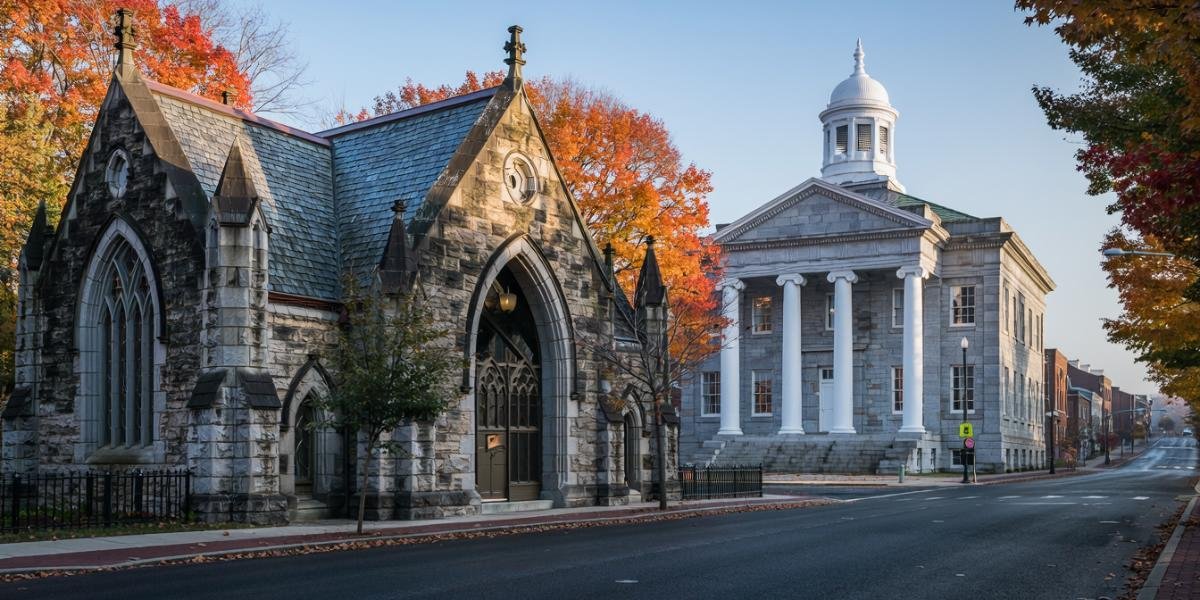
Two buildings anchor the center of downtown Madison, NJ: the Gothic-style train station on Kings Road and the granite Hartley Dodge Memorial across the street, which serves as the borough hall. Both came from a mix of local investment and private generosity in the early 1900s, and both still shape how the town looks today.
Scott Spelker of The Spelker Team at Coldwell Banker Realty has lived in Madison for about 50 years and serves as the town historian. He leads local history tours, including Revolutionary War tours this year for the nation’s 250th anniversary and an annual cemetery tour for Madison seventh graders. Here is how he explains the story behind both buildings.
Madison Had Rail Service Almost From the Start
The first passenger trains reached Madison in 1837, very early in the history of American railroads, and they were pulled by horses. Steam locomotives took over in the years that followed. For a short time, Madison was the end of the line before the tracks continued to Morristown.
“Really from the outset, when the train started to become a thing in this country, there was a train line that ran out to Madison,” Spelker said.
Several modest stations served the town over the next 80 years. The building residents know today opened in 1916.
A Station Project Madison Chose to Fund
Around 1914, the Delaware, Lackawanna and Western Railroad, which ran the Morris and Essex line, was planning to raise its tracks through the area. As Spelker tells it, the railroad offered towns along the line help building newer, better stations, similar to matching funds. Madison was the town that took the offer.
Residents approved $159,000 in bonds for the project. Spelker estimates the full cost, including elevating the tracks through downtown, at roughly $300,000. Much of the remaining work was funded by Mrs. D. Willis James, the widow of one of Madison’s wealthiest residents, who paid for much of the road grading the track elevation required.
“You can give the credit to the foresight of the people in the town to say, we really want to do this, and also to having a wealthy benefactor in town,” Spelker said.
The result was a Collegiate Gothic station designed by architect Frank J. Nies, now listed on the National Register of Historic Places. Spelker says it looks like it belongs on the Princeton campus and ranks it among the two or three finest train stations in New Jersey. Raising the tracks also meant trains no longer crossed downtown streets at street level.
The Story Behind the Hartley Dodge Memorial
The borough hall was a gift from Geraldine Rockefeller Dodge, daughter of Standard Oil’s William Rockefeller, and her husband, Marcellus Hartley Dodge, the head of Remington Arms. In 1911, the couple bought the former James estate in Madison, which became Giralda Farms.
Their only son, Marcellus Hartley Dodge Jr., died in a car accident in France in August 1930 at age 22, shortly after graduating from Princeton. As Spelker tells the story, Hartley had wanted to fly airplanes. His mother thought that was too dangerous and encouraged him to tour Europe by car with friends instead.
In her son’s memory, Mrs. Dodge bought land in the center of town, where several houses were moved or taken down to make room. The Dodges donated $800,000 for the building, and it was dedicated on Memorial Day in 1935. Construction took place during the Great Depression, which Spelker notes gave work to skilled tradespeople from Madison and the surrounding area.
The building is made of granite, limestone, and marble, with six fluted columns across the front and an octagonal cupola on top. Spelker points to the New Hampshire granite and the bronze doors as details that set it apart.
“Size is a big part of it, but you can have a large building that’s unattractive,” he said. “It is beautifully designed. It’s well proportioned. It’s built to last hundreds of years.”
Mrs. Dodge also filled the building with art from her own collection. In 2017, the Hartley Dodge Foundation announced that a marble bust of Napoleon that had sat in the building for decades was an authenticated work by Auguste Rodin.
A Downtown That Draws Film Crews
The station, the Hartley Dodge Memorial, and the Presbyterian church together form the heart of downtown.
“You put those three things together and you’re really hard pressed to find a more beautiful, quintessential downtown American town than you have right here in Madison,” Spelker said.
That setting has made Madison a regular filming location. The holiday movie The Family Stone shot town scenes here, and The Housemaid, released in 2025, used a historic Madison home as its central house. Spelker remembers a production in the 1970s on Lincoln Place, right behind the station, where crews spread fake snow and lined the street with cars from the 1940s. He and his friends climbed onto a store roof to watch until someone on set spotted them and asked them to come down.
For Spelker, this history is part of how he introduces buyers to Madison. Readers can learn more about Scott Spelker’s background as a Madison agent and town historian.
The Spelker Team is a husband-and-wife real estate team at Coldwell Banker Realty in Madison, NJ, serving buyers and sellers across Morris County, including Madison, Chatham, Morristown, and Summit. Scott Spelker brings 25 years of Wall Street trading experience and serves as Madison’s Town Historian, and Amy Spelker brings a professional background in interior design.
Disclaimer: This article is based on information provided by the expert source cited above. It is intended for general informational purposes only and does not constitute legal, financial, or real estate advice. Readers should conduct their own research and consult qualified professionals before making any real estate or financial decisions.