
A merchant cash advance is an arrangement in which a business sells a portion of its future sales in exchange for immediate cash. It’s generally not structured as a loan, and it can often be funded within about one business day. The clearest way to understand it is to follow a single advance from the first phone call through the final remittance.
Meet Harbor Street Coffee, a fictional two-location café with $80,000 in monthly sales. Its owner needs $35,000 to replace an espresso machine and add a walk-up window before the busy season. Here’s the life of that advance.
Day 0, 8:30 a.m.: The Application
Harbor Street’s owner completes a short online form and uploads four months of bank statements, card processing statements, a driver’s license, and a voided check. Most funders ask for the same basics, and some connect to your bank electronically.
The funder’s reviewer looks for:
• Monthly revenue and how steady it is
• Number of deposits and negative-balance days
• Time in business
• Existing advances, known in the industry as “positions”
• Liens, judgments, and any recent bankruptcy
Credit still gets checked, but sales patterns tend to carry most of the weight. Comparing products before you apply is useful at this stage, and an overview such as Fundivi merchant cash advance information can help you identify the questions to ask.
Day 0, 11:00 a.m.: The Offer
The offer arrives:
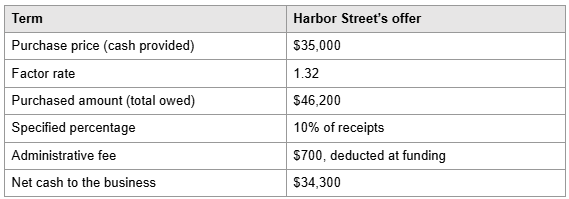
The owner notices two details. First, the actual cost isn’t 32% of a loan held for a year. It’s $11,900 against $34,300 of net cash, repaid over a matter of months. Second, the deal has no interest rate, which means comparing it to a bank quote requires some work.
Day 0, 1:30 p.m.: The Hard Questions
Before signing, the owner asks the sales representative these questions and requests the answers by email:
• How do remittances actually work: a true percentage or a fixed daily estimate?
• If sales drop, how do I get my payment adjusted?
• Is any discount available if I finish early?
• Does the personal guarantee apply only to breaches of the agreement?
• Does this agreement include a confession of judgment?
• Who is the funder, and are you the funder or a broker?
Question 2 is the most important. A hallmark of a true receivables purchase is that the funder shares the risk of lower sales. Many agreements include a reconciliation provision that adjusts fixed debits to match actual revenue.
The owner also reads a Manila Times look at card-based merchant funding, since a loan-style card product could offer an alternative with a different legal structure.
Day 0, 3:00 p.m.: Verification and Signature
The funder conducts a short recorded call, confirms ownership, and verifies the bank account. Some states, including California and New York, require particular commercial financing disclosures for many such deals, so the owner reviews that document as well. Then comes the e-signature.
Why does the process move so fast? A short review of sales data replaces most of what a bank would need, such as appraisals, full financial statements, and committee approval.
Day 1: The Money Arrives
Funds arrive by wire or ACH, usually the same day or the next business day, depending on when the file closed. Harbor Street has $34,300 in its account the next morning. A Friday afternoon closing could have delayed this until Monday.
Week 1: Remittances Begin
Under a 10% holdback, on a $2,600 sales day the funder collects $260. The owner quickly realizes that the real experience of an advance is a daily reduction in available cash. Payroll and supplier payments need to be planned around it.
At $80,000 in monthly receipts, 10% equals about $8,000 monthly. Harbor Street’s expected timeline:
• $46,200 ÷ $8,000 ≈ 5.8 months
Month 2: The Offer to Stack
An unknown company calls: “You’re pre-approved for another $30,000.” Harbor Street’s owner declines. A second advance would mean another share of sales and would probably violate the first agreement. Plenty of owners don’t turn down that call, and that’s where cash problems tend to become serious.
Protective habits at this stage include:
• Treating unsolicited offers skeptically and independently verifying the company
• Comparing any renewal’s net cash with its full new cost
• Keeping money for the debits in a separate account
Independent research helps with this kind of decision as well. A list of business loans you can prequalify for quickly gives a sense of alternatives that may cost less.
Month 3: The Slow Stretch
Road construction blocks the street and sales fall 30%. On a true percentage split, remittances fall automatically. On a fixed debit, the owner must ask for reconciliation.
Harbor Street’s owner sends bank statements and a written request as the contract requires. The daily debit is adjusted to better reflect current sales. The balance doesn’t disappear, of course, but the business stays open.
The lesson: communicate early and in writing. Moving deposits to another account to avoid debits, by contrast, is usually a default and can lead to serious consequences.
Months 4 to 6: The Finish
The new walk-up window pays off. Sales rise, percentage collections speed up, and the purchased amount is delivered in about five and a half months.
Was it worthwhile? Harbor Street paid $11,900 in total costs. The new espresso machine and walk-up window added capacity that stayed in the business after the advance ended. For this café, the advance was expensive but justified.
A different owner, using the same $35,000 to catch up on overdue bills, would have ended the six months with the same underlying problem and $11,900 less.
Who Tends to Use Advances, and Who Should Avoid Them
Advances are especially common among restaurants, salons, auto shops, convenience stores, and other businesses with frequent daily sales and limited access to bank credit. Frequent deposits let funders collect steadily, which helps explain why these industries get approved so often.
Those strengths don’t make every such business a good candidate. Owners should think twice if their net margin is under 10%, if another advance is already being repaid, or if a large share of revenue comes in only a few weeks of the year. A holdback that’s manageable in June can be crushing in February. Before accepting, calculate what remains of an average day’s sales after the remittance, rent, labor, and supplies are covered.
The Takeaway From the Timeline
An MCA can be fast because it’s priced for risk and based on easily verified sales. It can work when the cash has a clear, profitable use and the business has the margin to absorb the holdback. It can do real damage when it’s used to cover ongoing losses or layered on top of other advances.
If you have the time and credit for cheaper options, try those first. A line of credit, term loan, or vendor financing could cost a fraction of the amount, and resources such as the CompareBusinessLoansOnline.com rate comparisons can add other providers to consider.
Frequently Asked Questions
Is a merchant cash advance legal?
Yes, in general, though state laws differ and some agreements have been challenged as disguised loans. Disclosure rules apply in certain states.
Do I need a certain number of months in business?
Many funders look for several months to a year or more. Requirements vary, and newer businesses may see lower amounts.
What’s a “position” in MCA terms?
It refers to the order of advances against your receipts. A first-position funder is the only one or the earliest one collecting.
Does my business need to accept credit cards?
Not necessarily. Many current products rely on bank deposits and fixed ACH debits.
What happens if I go out of business?
Under a true purchase of receivables, closure without any breach may not create automatic personal liability, but contract terms control. Consult an attorney.
Can I renew an advance?
Often, after a portion has been repaid. Calculate how much new cash you’ll actually receive after paying off the balance.
Will an advance show up on my credit report?
Routine remittances usually aren’t reported, though funders may check your credit and file a UCC lien that other lenders can see. Serious defaults may lead to collections or a lawsuit.
Disclaimer: This article is provided for general informational and educational purposes only and should not be considered financial, legal, tax, or lending advice. Merchant cash advances and other business financing products may have different structures, costs, repayment obligations, and legal requirements depending on the provider, agreement, and applicable state laws. Approval, funding times, repayment amounts, and other terms are not guaranteed and vary by business and provider. Before entering into a merchant cash advance or other financing agreement, carefully review the complete contract, including fees, remittance requirements, personal guarantees, liens, default provisions, and any reconciliation terms. Businesses should consult qualified financial and legal professionals regarding their specific circumstances before making financing decisions.