
Not every lender requires a business plan. Many online lenders decide based on bank statements and revenue alone. But for SBA loans, bank loans, community lenders, startup financing, acquisitions, and larger requests, a concise plan can make a significant difference. It answers questions before they are asked and shows that you have thought carefully about how the money will be used and repaid. Even when a lender does not formally require one, the process of writing a plan forces you to test your own assumptions, which often leads to a smarter request.
A lender-focused plan is different from a plan written for investors or internal strategy. It is shorter, more conservative, and centered on one theme: repayment. Below is a template you can adapt. Replace the bracketed prompts with your own information, and use the tips to strengthen each section.
Section 1: Executive Summary
Keep this to one page or less. Many reviewers read it first and sometimes read only this section closely.
[Business name] is a [legal structure] founded in [year] and located in [city, state]. We provide [products or services] to [target customers]. Over the past [time period], we generated [revenue figure] in revenue with [profit or margin figure].
We are requesting [loan amount] in the form of [type of financing] to [specific purpose]. We expect this investment to [measurable outcome, such as increase revenue by X or reduce costs by Y] within [time frame]. Repayment will come from [primary source of repayment].
Tip: Lead with the request and the repayment source. Lenders want to know immediately what you need and how they will be repaid.
Example of a completed summary (fictional business):
Harbor Street Print Co. is a limited liability company founded in 2019 and located in Portland, Maine. We provide commercial printing and signage to restaurants, real estate offices, and local events. Over the past twelve months, we generated $640,000 in revenue with a 14 percent net margin.
We are requesting $85,000 in equipment financing to purchase a wide-format printer and laminator. We expect this investment to add approximately $9,000 in monthly revenue from large-format jobs we currently outsource, within six months. Repayment will come from operating cash flow, supported by existing contracts with three regional real estate firms.
Section 2: Company Overview
- Ownership: [Names and ownership percentages]
- History: [Brief timeline of key milestones]
- Location and facilities: [Owned or leased, size, lease term]
- Employees: [Number of full-time and part-time staff]
- Licenses and certifications: [Relevant credentials]
Tip: Mention lease terms clearly. A lender financing improvements to a space you only have for another year will have concerns.
Section 3: Products, Services, and Customers
We offer [main products or services]. Our customers are primarily [customer description]. Our largest customer accounts for approximately [percentage] of revenue. Customers typically pay [payment terms].
Tip: Be honest about customer concentration. If one client is a large share of revenue, explain the relationship’s stability, such as contract length or history. Mention any steps you are taking to broaden your customer base.
Section 4: Market and Competition
Our market is [geographic area or online segment]. Key competitors include [two or three competitors]. We differentiate ourselves through [specific advantages, such as price, quality, speed, specialization, or relationships]. Industry trends affecting us include [relevant trends].
Tip: Avoid inflated claims about market size. Lenders prefer grounded, local, verifiable observations over sweeping national statistics, such as a waiting list, signed contracts, or repeat orders.
Section 5: Management Team
[Owner name], [title]: [Years of experience, relevant background, key skills]
[Key manager name], [title]: [Experience and responsibilities]
Advisors: [Accountant, attorney, mentors, if applicable]
Tip: Experience is a major factor in lending decisions, especially for startups and acquisitions. Highlight industry-specific background, and if your own experience is limited, show how advisors, partners, or key employees fill the gap.
Section 6: Use of Funds
This is one of the most important sections. Be specific.
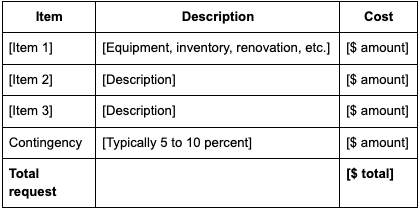
The owner(s) will contribute [amount] from [source] toward the total project cost of [amount].
Tip: Attach quotes or invoices where possible. Specific figures from vendors carry more weight than estimates.
Section 7: Financial History
Include or attach:
- [Two to three years of business tax returns]
- [Year-to-date profit and loss statement]
- [Current balance sheet]
- [Debt schedule showing all existing obligations]
Brief explanation of trends: [Explain growth, declines, or one-time events]
Tip: If there was a down year, address it directly. A sentence explaining a temporary disruption is far better than leaving the lender to guess.
Section 8: Financial Projections
We project revenue of [amount] in Year 1, [amount] in Year 2, and [amount] in Year 3, based on [key assumptions]. With the new loan payment of approximately [monthly amount], projected cash flow available for debt service is [amount], resulting in a coverage ratio of approximately [ratio].
Tip: Provide three scenarios if possible: conservative, expected, and optimistic. Show that the business can repay even under conservative assumptions. Lenders are skeptical of projections that leap dramatically above historical performance.
Section 9: Repayment Plan and Risk Mitigation
The primary source of repayment will be [operating cash flow from specific activities]. Secondary sources include [collateral, personal assets, other income].
Key risks and our plans to address them:
- [Risk 1]: [Mitigation]
- [Risk 2]: [Mitigation]
- [Risk 3]: [Mitigation]
Tip: Naming risks yourself builds credibility. Every business has risks; lenders worry more about owners who seem unaware of theirs.
Section 10: Appendix
- Owner resumes
- Vendor quotes and invoices
- Lease or property documents
- Licenses and permits
- Key contracts or letters of intent
- Photos of the location or equipment, if helpful
How Long Should It Be?
For most small business loans, ten to fifteen pages plus attachments is plenty. A startup or acquisition request may justify more detail, particularly in the projections and management sections. A smaller working capital request may need only a two-page summary covering the request, use of funds, financial history, and repayment. Length is not a measure of quality; clarity is.
Common Mistakes That Weaken a Plan
Copying a generic template word for word. Lenders recognize boilerplate instantly. Make every section specific to your business.
Projections disconnected from history. A business that grew 8 percent last year projecting 70 percent growth needs an extraordinary explanation.
Vague use of funds. “Working capital and growth” tells the lender nothing. Itemize.
Ignoring existing debt. Leaving obligations off the plan, only for them to appear on your credit report, damages trust.
Overlong narratives. Underwriters are busy. Tight, factual writing is more persuasive than pages of enthusiasm.
Before You Submit: Research and Match
A strong plan is most effective when it reaches the right lender. Different lenders focus on different loan sizes, industries, and borrower profiles, and a plan written for an SBA lender may need adjustments for a community lender or equipment financer.
Take time to research before you apply. Comparison tools like Compare Small Business Loans help you understand which product types fit your request. Directories such as Business Loans Companies can point you toward lenders that work with businesses like yours. Business Loans Blog offers practical guidance on what lenders typically expect. If timing is critical, Same Day Business Loans Online explains how expedited products differ, though fast lenders rarely require a full plan.
Then tailor your plan to the one lender that fits best and submit it there. It may seem efficient to send the same plan to a long list of lenders, but this tends to hurt more than help. Each application can bring a hard credit inquiry, and several together can reduce your score. Lenders who sense that your package is being circulated widely may give it less attention. And a generic plan aimed at everyone rarely speaks convincingly to anyone. A focused submission, tailored to one lender’s priorities, makes a far stronger impression. If the answer is no, use the feedback to refine your plan before approaching the next lender.
Final Checklist
- [ ] Executive summary states the request and repayment source clearly
- [ ] Use of funds is itemized with quotes where possible
- [ ] Financial history is complete and explained
- [ ] Projections include conservative assumptions
- [ ] Risks are named and addressed
- [ ] Numbers match across every document
- [ ] Plan is tailored to the selected lender
A lender-ready business plan does not need to be long or elaborate. It needs to be clear, honest, and focused on how the loan will be repaid. Fill in this template thoughtfully, match it to the right lender, and you will give your application the best possible chance of success. Keep a copy, too; updated each year, it becomes a ready foundation for every future request.
Disclaimer: This article is intended for general informational and educational purposes only and does not constitute financial, legal, or professional lending advice. The business plan template and examples provided are for illustrative purposes and do not guarantee loan approval or financing eligibility. Loan requirements, terms, interest rates, and approval criteria vary by lender and individual business circumstances. Readers are encouraged to conduct their own research and consult with qualified financial or legal professionals before making financing decisions or submitting loan applications.