
A homeowner with a scheduled foreclosure sale can still stop it by selling the house and paying the lender in full before the auction date. The mechanism is a signed purchase contract, a buyer with verified funds, and a closing that delivers the payoff to the servicer before the sale is held. Servicers often postpone auctions when that package arrives, and a completed closing ends the foreclosure.
Why Does a Sale Stop the Foreclosure When a Payment Plan Often Does Not?
Foreclosure exists to collect a debt. A sale that pays the full balance, including missed payments, late fees, and the lender’s legal costs, removes the reason for the auction. A repayment plan asks the lender to keep waiting, and lenders weigh that request against the borrower’s income and history. A payoff requires no evaluation, which is why a contract with real money behind it changes the conversation so quickly.
Federal rules set the early boundaries. Under the Consumer Financial Protection Bureau’s mortgage servicing rule, Regulation X section 1024.41, “A servicer shall not make the first notice or filing required by applicable law for any judicial or non-judicial foreclosure process unless: (i) A borrower’s mortgage loan obligation is more than 120 days delinquent.” That is roughly four missed payments. After that point, the state’s process takes over, and the speed varies enormously: Texas and Georgia can reach the courthouse steps within weeks of the first notice, while Florida, Illinois and New York run through the courts and commonly take a year or more. The HomeWise foreclosure timeline tool maps those state-by-state windows for owners who need to know how many days they actually have.
What Does the Homeowner Need to Do, and in What Order?
The sequence below is the one title companies and experienced buyers follow when a sale date is already set.
The sale date and the reinstatement and payoff figures, in writing. The servicer must provide a payoff statement on request. The payoff is the full balance to end the loan, and the reinstatement figure is the smaller amount to bring it current. Both expire on a stated date and both grow daily.
Confirmation that equity exists. A sale only works when the house is worth more than the payoff plus closing costs. A recent comparable sale or a buyer’s written offer answers this within a day.
A signed contract with a buyer who can close before the sale date. That means a buyer using its own funds, a title company already named, and a closing date inside the window. A financed buyer needs 30 to 45 days for underwriting, which is usually too long.
A postponement request supported by the contract, the proof of funds, and the closing date. The request goes through the servicer’s loss mitigation department, not the collections line. Many servicers will move the sale 30 days when the file shows the loan will be paid off.
A closing where the title company wires the payoff the same day. The title company orders a fresh payoff, pays the lender from the sale proceeds, and releases the remaining equity to the seller. The foreclosure case is dismissed, or the trustee’s sale is canceled once the lien is satisfied.
Homeowners should consult a licensed attorney in their state before acting, because the deadlines and notice rules differ from state to state, and a missed date is not recoverable.
How Much Time Is There, Really?
It depends on the state. The table below shows the range between the first formal notice and the earliest possible sale in several large markets, based on each state’s statutory minimums and assuming the servicer moves at full speed.
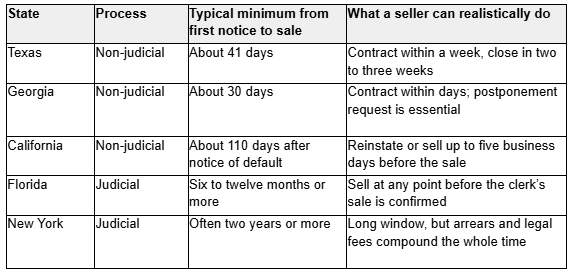
The pressure is not evenly distributed. According to ATTOM’s Mid-Year 2026 U.S. Foreclosure Market Report, 227,548 properties had foreclosure filings in the first half of 2026, up 21 percent from a year earlier, and Florida, South Carolina, Indiana, Delaware and Illinois posted the highest rates. The same report put the average time to complete a foreclosure at 563 days, the shortest since 2013. Timelines are getting shorter, not longer.

Where Does a Direct Buyer Fit?
Most owners in this position are not choosing between a cash buyer and a retail listing. They are choosing between a cash buyer and the auction. A listing takes weeks to attract an offer and a further month or two to close, and a financed buyer’s lender adds underwriting conditions when a foreclosure sale date is on the file.
HomeWise, a direct home-buying company that purchases distressed single-family houses, including houses with a scheduled foreclosure sale, in Florida, Texas, Georgia and other states, works the process from the servicer’s side as much as the seller’s. Its acquisitions team requests the reinstatement and payoff figures on day one, submits its proof of funds and the ratified contract to the servicer’s loss mitigation department to support a postponement, and pays the arrears, late fees and penalties out of the purchase price at closing so the seller never has to bring money to the table. A step-by-step explainer on how to stop a foreclosure by selling the house, including what the payoff letter looks like and how the equity is released, is published on its site.
None of this is certain. A servicer can decline a postponement, an auction can go forward if the file arrives late, and a house with no equity cannot be sold for enough to clear the debt. What a direct buyer changes is the odds, by removing the two things that kill most last-minute sales: financing risk and time.
What Do the Regulators Tell Homeowners to Do?
The federal guidance is consistent and blunt. The Department of Housing and Urban Development’s Avoiding Foreclosure page states plainly, “Lenders do not want your house,” and tells owners to contact the lender as soon as a problem appears and to reach a HUD-approved housing counselor, whose help is free. The Consumer Financial Protection Bureau’s foreclosure explainer says the same: “Don’t wait for the foreclosure process to begin. Reach out for help as soon as you think you might have trouble paying your mortgage.”
Counselors can negotiate a modification or a repayment plan, and for an owner who wants to keep the house, those are the first calls to make. For an owner whose income no longer supports any plan, the counselor’s advice often lands where buyers such as HomeWise land on the first phone call: sell before the date, keep the equity, and let the closing end the foreclosure.
Frequently Asked Questions
Can a house be sold after the foreclosure sale date is set?
Yes. A homeowner can sell and pay off the loan at any point before the sale is held, and in California, reinstatement is allowed until five business days before the auction. The practical limit is time. The buyer must close and deliver the payoff before the scheduled date.
Does the servicer have to postpone the sale if a contract is submitted?
No. Postponement is at the servicer’s discretion, though it is commonly granted when a ratified contract, proof of funds, and a near-term closing date show the loan will be paid in full. Federal rules only require a servicer to pause a sale when a complete loss mitigation application arrives more than 37 days before the sale.
What happens to the equity when the house sells before auction?
The title company pays the lender’s payoff, any junior liens, and closing costs from the sale price, and the seller receives the remainder by wire or check at closing. At a foreclosure auction, by contrast, surplus funds go to the owner only if the winning bid exceeds the debt and costs, which is uncommon.
Is selling to a cash buyer the only way to close in time?
No, but it is the option that fits the shortest windows. A financed buyer can close before an auction if underwriting finishes in time, but 30 to 45 days is typical. Owners with 90 days or more can often list the house, while owners with 30 days usually cannot.
Disclaimer: This article is intended for general informational and editorial purposes only. It does not provide legal, financial, tax, real estate, mortgage servicing, foreclosure defense, or professional advice, and it should not be relied upon as a substitute for guidance from qualified professionals. Foreclosure timelines, auction postponements, reinstatement rights, payoff requirements, loss mitigation rules, equity outcomes, closing timelines, and lender or servicer decisions can vary by state, loan type, lender, servicer, court process, property condition, title issues, and individual circumstances. Homeowners facing foreclosure should promptly consult a licensed attorney, HUD-approved housing counselor, tax professional, real estate professional, or other qualified advisor before signing a contract, requesting a postponement, accepting an offer, or making decisions about selling a property.