For estate and real estate agents, property marketing increasingly begins before an agency is formally appointed.
At a market appraisal, sellers are comparing more than valuations and fees. They also want to understand how each agency would position the property, which buyers it would target, and what the marketing campaign could look like once appointed.
That is changing the role of visual technology. Virtual staging is no longer useful only after the photography is complete. Used earlier in the listing-preparation process, it can help agents turn a proposed marketing strategy into something sellers can actually see, making it easier to communicate the vision for the property before it goes to market.
Showing the marketing plan, rather than describing it
Agents have traditionally explained how an empty, dated or poorly furnished property could be presented. They might recommend physical staging, selective redecoration, decluttering or a different photographic approach.
The difficulty is that these conversations remain abstract. A vendor may understand the recommendation without being able to picture the result.
Spatial virtual staging provides a more tangible alternative. Once initial photographs are available, an agent can demonstrate how the same property might appear with a different furniture layout, a more appropriate interior style or a clearer visual identity for the intended buyer audience.
This can make the marketing conversation more specific. Instead of promising that a vacant reception room will “look more inviting”, the agent can show the vendor a proposed direction and explain how it fits the positioning of the property.
The technology therefore has potential value before portal launch, and even before the agency’s full marketing package has been approved.
Why consistency across a gallery matters
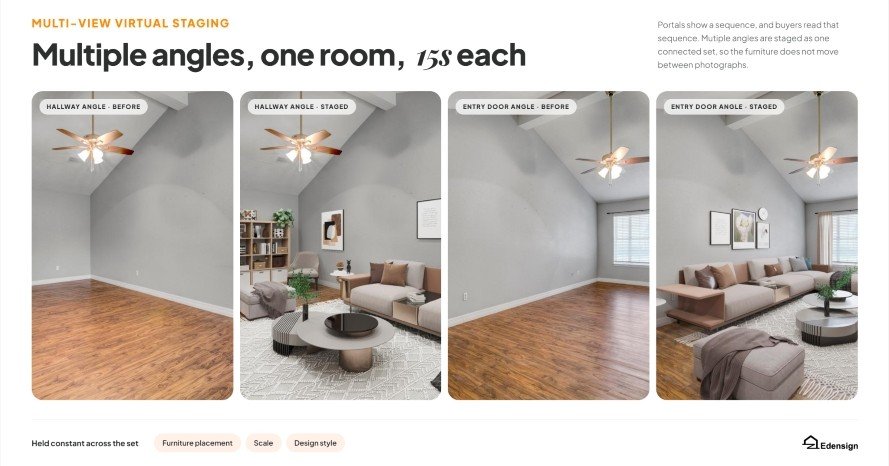
Many virtual-staging tools process each photograph independently. The result may look convincing as a single image, but difficulties become apparent when several angles of the same room are placed together.
A sofa may move from one wall to another. A table may change size. Artwork, lighting or decorative objects may appear in one photograph and disappear in the next.
For an estate agent, this is more than an aesthetic problem. Property portals present a sequence of images, and buyers use that sequence to understand the relationship between rooms, openings and circulation. When the staging changes between viewpoints, the gallery can become harder to interpret and the editing more obvious.
Edensign’s Multi-View Virtual Staging is designed to address this issue. The platform creates a spatial understanding of the room and uses it to maintain furniture placement, scale and design style across multiple camera angles. Agents can currently process up to four views of the same room as a connected set rather than treating them as unrelated photographs.
The practical difference is that the result functions more like a visual tour. Buyers are able to see not only how an individual image has been improved, but how the proposed furniture arrangement relates to the room as a whole.
This can be particularly valuable for vacant properties, premium instructions, new developments and homes whose proportions are difficult to understand from a single photograph.
A new tool for the valuation conversation
The most important agency application may not be the final listing gallery. It may be the market appraisal itself.
Most vendors hear broadly similar promises from competing agents: professional photography, portal exposure, social promotion and access to qualified buyers. Spatial visualisation gives an agent an opportunity to make the proposed campaign more concrete.
For example, an agent could demonstrate:
- how an empty principal bedroom might be positioned for a family buyer;
- how dated furniture could be removed from the marketing images;
- how several reception-room photographs could be staged as one coherent sequence;
- or how a two-dimensional floor plan might be developed into a more accessible three-dimensional visual.
The purpose is not to guarantee a particular response from the market. It is to give the vendor a clearer picture of the agency’s proposed strategy.
That can help move the appraisal conversation beyond fee and valuation alone. The agent is able to discuss presentation, audience and launch planning with visual evidence rather than relying entirely on verbal assurances.
From individual edits to a repeatable agency workflow
For an independent agent handling a small number of instructions, creating one staged image may be enough. For a multi-branch agency or a team processing a larger volume of properties, the challenge is different.
The business needs a repeatable process.
Photographs may pass between valuers, branch staff, photographers, administrators and marketing teams. Vendors may need to approve a particular treatment. Different employees may make different decisions about image order, design style or which objects should be removed.
A connected listing-preparation platform can help standardise some of those decisions.
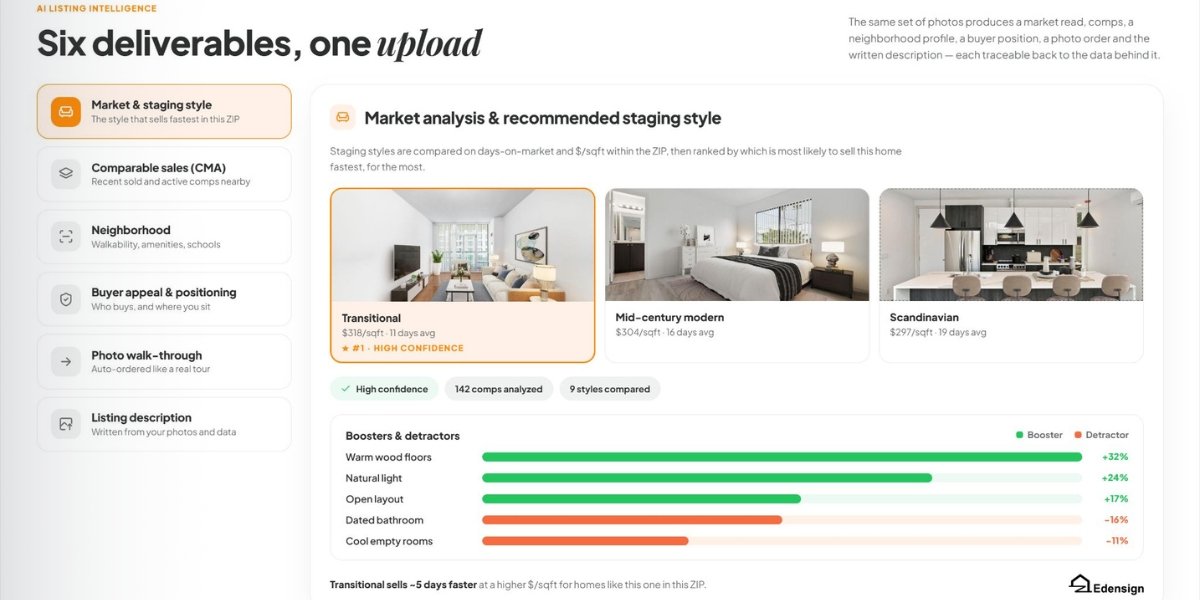
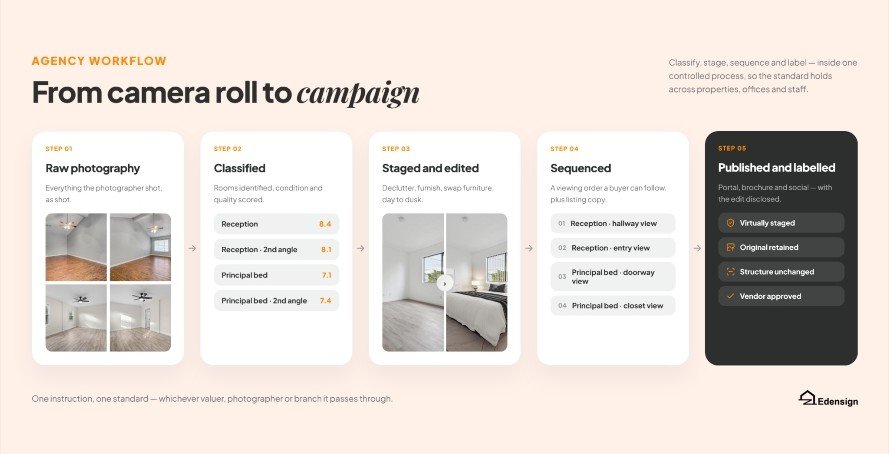
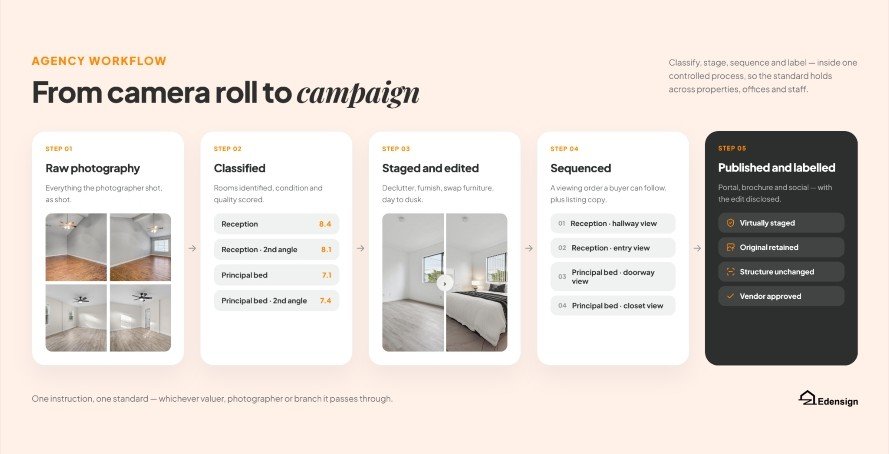
Edensign brings together virtual staging, furniture removal and editing, decluttering, multi-view staging, 3D virtual staging and 2D-to-3D floor-plan conversion. Its wider Listing Intelligence workflow can also classify property photographs, suggest a logical viewing sequence and prepare property copy from the supplied images and data.
For an agency, the relevance is not simply having more AI tools. It is the possibility of moving from raw photography to a coordinated set of marketing materials within one controlled workflow.
That could make it easier to maintain a consistent standard across different properties, offices and members of staff.
Supporting professional judgement, not replacing it
There is still an important distinction between helping a buyer understand a property and changing what is being offered for sale.
Agents remain responsible for deciding which presentation is appropriate, whether the result reflects the actual property and how edited images should be described. Permanent architectural features, room proportions, windows, doors and the condition of the property should not be materially misrepresented.
Virtually staged or substantially altered images should also be clearly identified. The more realistic AI imagery becomes, the more important transparency is to maintain trust with buyers and vendors.
This is particularly relevant for agencies because an image may pass through several hands before appearing on a property portal, brochure or social channel. The quality and consistency of the underlying technology therefore matter. Edensign, for example, reconstructs a room in 3D before adding furniture, helping staged elements remain consistent across different views of the same space rather than treating each photograph as an isolated image.
That consistency can make virtual staging more credible, but it does not remove the need for clear agency policies. Teams still need to decide which edits are appropriate, how virtually staged images should be labelled, and when the original photograph should also be retained or displayed.
The agent’s role is becoming more strategic
The next stage of virtual staging is not simply about generating a more attractive room.
For estate agents, its broader value lies in connecting the market appraisal, vendor presentation, listing preparation and buyer-facing campaign.
An agent who can show how a property will be positioned, explain why a particular visual direction has been chosen and deliver that direction consistently across the listing may be able to offer a more convincing service than one relying on generic marketing promises.
Spatial AI will not replace local expertise, pricing judgement or the relationship between an agent and a vendor. But it can give that expertise a clearer visual form.
The competitive advantage may ultimately come not from using AI to produce more images, but from using it to present a more credible and better-prepared marketing plan.