During the first decade of the new millennium, the topic of climate change was discussed within scientific communities. Nonetheless, the vast majority of current concerns related to urban planning were not yet in focus. European heatwaves were less common. Net-zero goals did not become an integral part of governmental policies. The concept of buildings as one of the central instruments for both lowering greenhouse gas emissions and mitigating increased temperature levels was in its early stages.
Over the following two decades, those questions moved steadily toward the centre of energy and climate policy. The evolution of that conversation can be traced through the work of researchers whose careers have focused on the relationship between buildings, energy use and the urban environment. One of them is French scientist Frédéric Kuznik, whose research has ranged from airflow modelling and thermal storage to urban microclimates and heat-resilience strategies.
Kuznik is a Professor at the Institut National des Sciences Appliquées de Lyon (INSA Lyon) and a researcher at the Centre d’Énergétique et de Thermique de Lyon, better known as CETHIL. The laboratory is a joint research unit involving CNRS, INSA Lyon and Claude Bernard University Lyon 1. Beyond his academic activities, he directed CETHIL between 2018 and 2022. He led the joint EDF-CETHIL laboratory BHEE, devoted to highly efficient energy buildings, from 2015 until 2025. Since November 2023, he has represented France on the Executive Committee of the International Energy Agency’s Energy Storage Technology Collaboration Programme.
His research path did not begin with energy storage.
In 2005, Kuznik completed a doctoral thesis at INSA Lyon under the supervision of Jean Brau and Gilles Rusaouën. The subject concerned anisothermal airflow and ventilated cavities, a specialised area of building physics that examines how air and heat move through constructed spaces. Such questions may appear narrow, yet they sit behind practical concerns ranging from thermal comfort to energy consumption.
Around the same period, advances in computing were beginning to reshape engineering research. Numerical simulation was becoming increasingly important, particularly for problems that were difficult to reproduce experimentally. Kuznik became involved in studies using lattice Boltzmann methods, a computational approach for analysing fluid flow and heat transfer.
Several years later, these methods would become part of a broader effort to understand urban environments.
Working alongside researchers including Obrecht, Merlier, Bettaibi and Succi, Kuznik contributed to the development of highly parallelised simulations operating on graphics processing units. The objective was not simply faster computing. Researchers were seeking ways to model airflow and thermal exchanges across increasingly complex environments. Publications in Building and Environment and Sustainable Cities and Society examined applications ranging from mechanically ventilated rooms to urban-scale climate interactions.
Cities themselves were becoming a growing focus.
As concerns about urban heat islands intensified, researchers began paying closer attention to the interaction between buildings and their surroundings. Questions once limited to individual structures expanded toward entire neighbourhoods. Wind circulation, surface temperatures and heat accumulation became subjects of increasing interest. This shift aligned with Kuznik’s broader movement toward climate adaptation research and urban energy systems.
Another thread of his work developed in parallel. It would eventually become one of the most cited parts of his scientific record.
Thermal energy storage has long been viewed as a possible tool for reducing energy demand in buildings. One approach involves phase change materials, substances capable of storing and releasing heat as they transition between physical states. Throughout the late 2000s and early 2010s, Kuznik and his collaborators investigated how these materials could be integrated into building envelopes.
A review article published in Renewable and Sustainable Energy Reviews in 2011 attracted particular attention. Co-authored with David, Johannes and Roux, it examined phase change materials incorporated into building walls. It became one of the frequently cited references within the field. More than a decade later, an updated review by Lamrani, Johannes and Kuznik reflected the continued growth of research activity surrounding these technologies.
Not all storage systems rely on phase changes.
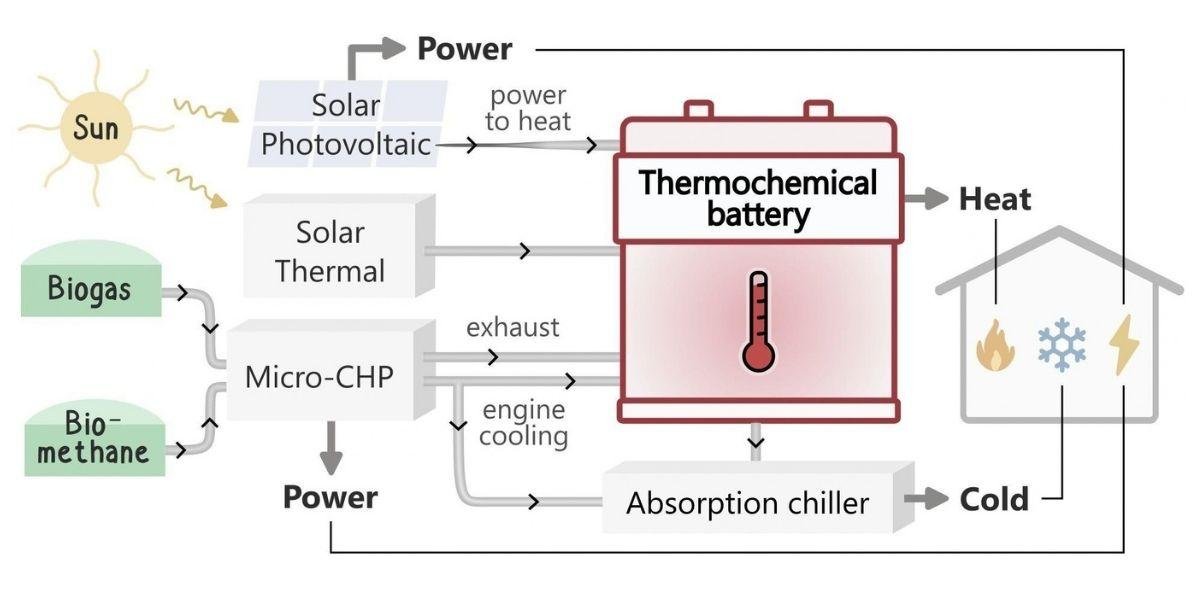
Some of Kuznik’s later work focused on thermochemical and sorption-based storage methods intended for longer-term energy retention. Researchers at CETHIL investigated materials such as zeolites, magnesium sulfate, lanthanum chloride, strontium bromide and ettringite. Laboratory experiments explored both thermodynamic behaviour and reaction kinetics, with the aim of understanding how heat might be stored over extended periods and recovered when needed.
These studies connected directly to wider debates about seasonal energy storage and low-carbon heating systems.
At the same time, Kuznik’s activities increasingly extended beyond individual technologies. Through the EDF-CETHIL partnership, research teams developed the MoDEM platform, a tool designed for predicting and managing energy demand at both building and district scales. Unlike conventional approaches that focus on isolated structures, the platform incorporated urban context and local climatic conditions. According to project documentation, the system remains in use within EDF research programmes.
Recent publications reveal another shift that has affected many engineering disciplines.
Machine learning began appearing alongside traditional physical modelling. In place of viewing these approaches as alternative approaches, several efforts attempted to integrate these different approaches. Data-based analysis in residential energy forecasting helped to see how data analysis could help peak-load forecasting without losing touch with the physics involved.
The topic of climate change adaptation has become more prominent in recent times.
Heat waves experienced by Europe in recent years have led to issues concerning people who were vulnerable. Projects with the involvement of Kuznik used simulations in buildings, along with modeling the physiology of the body. Some studies focused specifically on elderly women and the conditions they experience during periods of prolonged heat. The work linked engineering questions with broader discussions about public health and urban resilience.
Alongside research, Kuznik has remained active in international scientific networks. He is a member of the editorial boards of journals like Energy Storage and Sustainable Cities and Society Advances. He has worked as an evaluator for research programs conducted by entities like the European Innovation Council and the European Research Council. In 2024, he was the chairman of the scientific committee of Enerstock 2024 that took place in Lyon, one of the key conferences within the framework of the International Energy Agency’s energy storage program.
Recognition has followed at various stages of that career.
Stanford University’s widely referenced database of citation indicators included Kuznik in its Top 2% Scientists rankings every year from 2020 through 2025. In October 2024, the Chinese Academy of Sciences named him a Distinguished Scientist through its President’s International Fellowship Initiative. The following year, INSA Lyon awarded him its Research Medal.
Today, citation databases attribute more than 11,000 citations to his publications and an h-index of 50 on Google Scholar. Numbers alone do not explain the direction of a scientific career. Though they do not, these nevertheless show the interest garnered by various questions. In very different fields such as city overheating, phase-change materials, energy forecasting, and thermodynamic storage, Frédéric Kuznik’s research continues to revolve around the same issue: that of how buildings and cities adapt to changes in their energy and climate environments.