By: KeyCrew Media
Skyline now runs thirteen stations from East Kapolei to Middle Street, with the October 2025 opening of its second segment extending service to Pearl Harbor and Daniel K. Inouye International Airport. A third segment carrying the line through Kalihi to Civic Center is projected to open in 2031.
For retail owners on Oahu, the useful question is not what the line does today. It is what happens to the ground floor around a station once the pattern of movement settles – and that is a question with a long, well-documented answer in other cities.
Why the Line Began in the West
The route’s sequencing is frequently misread, and it follows a development logic rather than a ridership one.
The western corridor is where Oahu’s remaining open land sits, and where the island’s growth has been directed: master-planned communities, a second University of Hawaii campus, state and federal offices. The concept was a second urban center, reducing the number of residents making a ninety-minute journey into town each morning.
Building outward from there means the early stations serve areas whose density is still arriving. “There’s no density out there yet, so there’s no need for the retail component to be right at rail stops,” says Erin W.J. Mitsuyoshi, CCIM, of The Bratton Team at Colliers International Hawaii. That is a sequencing observation rather than a criticism – the retail case strengthens as the residential base fills in behind it.
The Order Things Happen In
Transit-adjacent retail follows a consistent sequence, and knowing it is what allows an owner to time a position.
The precondition is the pedestrian environment. A station generates retail demand only where the surrounding blocks are walkable, clean, well-lit, and served by proper sidewalks – where arriving on foot is pleasant rather than merely possible. Where those elements are in place, foot traffic follows, retailers follow the foot traffic, and residential development follows the retailers.
Mitsuyoshi puts the interval at roughly three to seven years for new retailers to commit around a station, and five to ten before ridership patterns are established enough to give operators full confidence in a location. Her observation about the local market is that renderings persuade fewer people here than elsewhere: commitment tends to follow construction rather than precede it.
That timing is precisely what creates the opportunity. Owners who position before the sequence completes acquire at pre-transit pricing.
The Design Question at Street Level
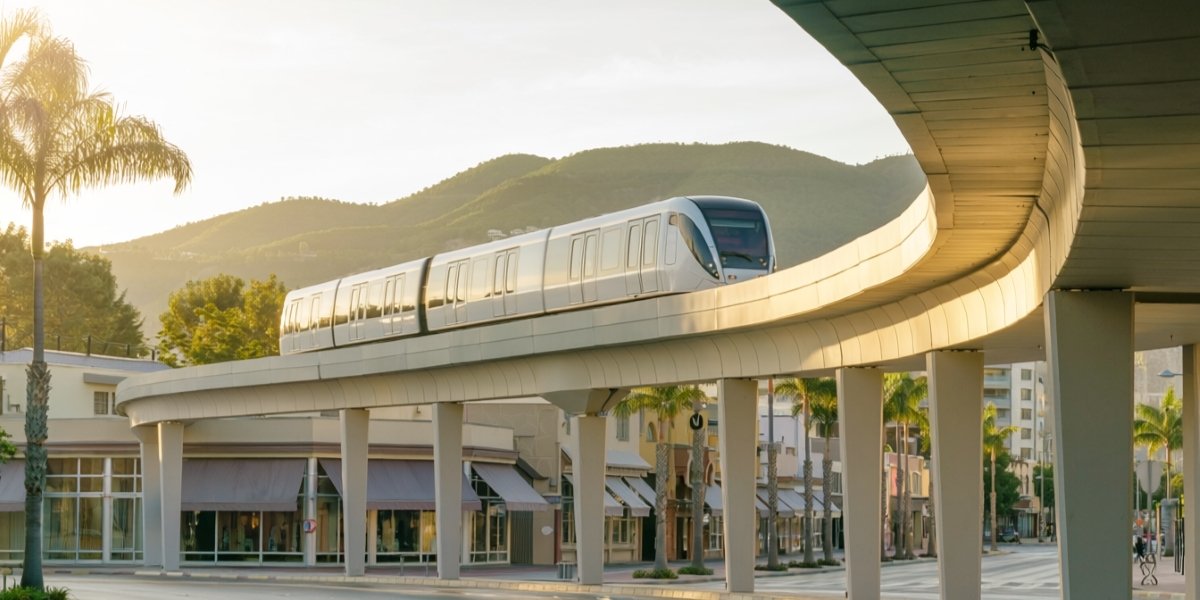
Skyline is an elevated system, built on pillars, which has a direct implication for where retail can sit.
Platforms are above street level, so there is no concourse retail of the kind found in underground networks. The commercial opportunity is at grade, in the buildings surrounding each station – which places it in the hands of adjacent landlords rather than the transit authority.
Some stations are currently configured primarily for drop-off and pick-up. Mitsuyoshi’s expectation is that neighboring landlords supply the retail component as demand materializes, through renovation of existing frontages and new development on adjacent parcels. That is a private-sector opportunity created by public infrastructure, and it is available to owners who hold or acquire the right positions.
Encouragingly, station design is being shaped with community input: HART completed neighborhood design workshops for all six Segment 3 stations in June 2026.
Renewal Along the Corridor
Construction has required land along the alignment for utilities and infrastructure, with some parcels acquired in full and others in part.
What that produces is a redevelopment opportunity running the length of the corridor. Much of the affected building stock is fifty, seventy, even eighty years old – assets that were approaching a renewal decision regardless of the rail line.
The infrastructure investment changes the economics of that decision. Rebuilding on a corridor with a fixed rail line, planned stations and public commitment behind it is a materially different proposition from rebuilding on the same site five years ago. Construction costs in Hawaii are high, which is why partnerships between landowners, developers and the state are likely to shape how much of this stock gets renewed and how quickly.
Where Change Comes Fastest
The final segment reaches the densest part of urban Honolulu, and Mitsuyoshi expects transformation there to move considerably faster than in the west.
The reason is that the ingredients already exist. Ground-floor retail is in place, the residential population is established, and the street-level vibrancy that takes a decade to build elsewhere is present. Adding a station to a functioning neighborhood is a different exercise from building a neighborhood around a station.
For owners holding retail in those districts, the line arrives as an addition to an already-working location rather than as a bet on one – which is why positions along the Segment 3 alignment warrant attention well ahead of opening. Current Hawaii inventory and the monthly market statistics offer a read on how corridor pricing is moving.
The Adoption Curve
Oahu is a driving island, with most households running two or three vehicles, and Mitsuyoshi is candid that the shift toward transit will take time – driven first by commuters for whom the line is simply the faster option, and broadening from there.
Weekday ridership currently runs at around 9,200, on a network that has not yet reached downtown. What that number represents is a base established before the line serves its principal destinations.
For retail owners, the timeline is the opportunity rather than the obstacle. Transit-oriented retail rewards those who position early, and Honolulu’s corridor is still in the phase where early is possible.
About the Expert
Erin W.J. Mitsuyoshi (B), CCIM, is an Associate Vice President with The Bratton Team at Colliers International Hawaii in Honolulu, specializing in retail leasing and landlord representation.
The Bratton Team is a Hawaii commercial real estate and investment sales group, exclusively contracted to Colliers International HI, LLC. Led by Mark D. Bratton (R) CCIM and Mike Perkins (S), the team has advised buyers and sellers across all Hawaii asset classes for 40 years.
Disclaimer: This article is based on information provided by the expert source cited above. It is intended for general informational purposes only and does not constitute legal, financial, or real estate advice. Readers should conduct their own research and consult qualified professionals before making any real estate or financial decisions.